Short Summary:
This blog contains
- An in-depth knowledge of what is influencer marketing?
- The types of influencers based on size, niche, content, brand partnership and platform dominance
- What AI influencers and how they are difference from human influencers
- Why brands like influencers and how to create an influencer marketing campaigns
- Benefits of influencer marketing and common mistakes to avoid
- What is influencer marketing ROI factors to consider
You’re scrolling Instagram at 11 PM, half asleep, when someone you’ve followed for two years holds up a skincare product and says it changed their routine. Before you even realise it, you’ve opened a new tab, and this doesn’t stop here alone; we have got an influencer everywhere in every industry, and you have probably scrolled past them a hundred times. A fitness creator casually mentions a protein powder. A tech reviewer unboxes a laptop. A travel blogger tags a hotel, and although everyone is talking about it (advertising), you don’t feel like you’re being advertised to.
Brands have figured out that people don’t want to be sold to. They want to hear from someone they trust. So they’ve moved budgets from TV spots and billboards to creators who’ve already built that trust, one video, reel, or thread at a time.
This guide covers everything: what is influencer marketing, how influencer marketing actually works, the types of influencers you’ll encounter, what to measure, and how to build a strategy that doesn’t fall flat.
What Is Influencer Marketing?
Influencer marketing is when a brand partners with an individual who has a loyal online following to promote its products or services. These individuals (influencers) aren’t just popular. They’ve earned genuine trust within a specific community, whether that’s fitness, finance, food, fashion, or any niche you can think of.
The reason it works is straightforward. People trust people. A recommendation from someone your audience already follows and respects carries far more weight than a banner ad or a polished TV commercial. When an influencer talks about a product, it lands like advice from a friend, not a pitch from a salesperson.
Brands collaborate with influencers on sponsored posts, product reviews, unboxings, tutorials, giveaways, and more. The content lives inside the creator’s feed, in their voice, and that’s what makes it feel natural.
Types of Influencers
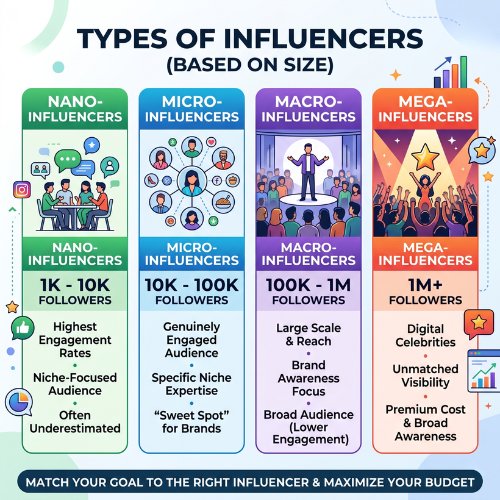
Not every influencer is the same, and the differences matter more than most brands realise when they’re starting out. Choosing the wrong type for your goal is one of the fastest ways to burn your budget.
Based on Size
Nano Influencers (Under 10,000 Followers)
Nano-influencers are the most underestimated category. They have small follower counts, usually between 1,000 and 10,000, but their engagement rates are consistently higher than anyone else in the chart.
What Is a Micro Influencer? (10,000 to 100,000 Followers)
Micro-influencers sit in a sweet spot most brands are now chasing. With a follower count between 10,000 and 100,000, they’ve built a genuinely engaged audience around a specific niche, whether that’s sustainable fashion, home workouts, budget travel, or sourdough baking.
Their high engagement rate comes from this specificity.
What Is a Macro Influencer? (100,000 to 1 Million Followers)
Macro-influencers have the scale. They’ve crossed into the territory where their content reliably reaches hundreds of thousands of people per post. Brands use them primarily for brand visibility and awareness campaigns when the goal is reach over depth of engagement. The trade-off is that their engagement rate tends to be lower than micro or nano-influencers’, and their audience is broader, which can mean less targeted reach.
What Is a Mega Influencer? (1 Million+ Followers)
Mega influencers are essentially digital celebrities. Think of creators like MrBeast, Bhuvan Bam, or any YouTuber who consistently pulls millions of views per video. Their brand visibility is unmatched, but they come with premium price tags and, often, highly fragmented audience engagement. They work best for global brands running awareness-heavy campaigns where broad reach is the primary metric.
Based on Niche and Industry
Beauty and Skincare
This niche is one of the most commercially successful areas on platforms like Instagram and YouTube. Influencers in beauty and skincare provide tutorials, product reviews, and skincare routines that resonate with their followers. They often collaborate with brands for product launches, leveraging their influence to drive sales and brand recognition. Their authenticity and relatability make them trusted voices in the industry, leading to significant consumer engagement and loyalty.
Finance and Fintech
Influencers in finance and fintech play a crucial role in demystifying complex topics such as investing, budgeting, and personal finance. By breaking down intricate concepts into digestible content, they empower their audiences to make informed financial decisions. These influencers often share tips, strategies, and personal experiences, fostering a community that values transparency and education. Their ability to connect with followers on a personal level enhances trust and drives engagement.
Gaming
The gaming industry is dominated by influencers who thrive on platforms such as Twitch and YouTube. These creators build deeply loyal communities around their gaming content, whether through live streams, gameplay tutorials, or commentary. Their engaging personalities and expertise attract viewers who share a passion for gaming, leading to high levels of interaction and community support. Brands looking to tap into this market often collaborate with gaming influencers to reach enthusiastic audiences who are eager to engage with relevant products and services.
Fitness and Wellness
In the fitness and wellness space, influencers create aspirational content that motivates and inspires their followers to lead healthier lives. They share workout routines, nutrition tips, and personal success stories that resonate with audiences seeking guidance and encouragement. The authenticity of fitness influencers fosters a strong sense of community, driving engagement and loyalty. Brands in this sector benefit from partnering with influencers who embody the values of health and wellness, reaching audiences who are already invested in their fitness journeys.
Travel and Hospitality
Influencers in the travel and hospitality niche excel at creating visually stunning content that captivates audiences on platforms like Instagram. They share travel experiences, tips, and destination highlights that inspire wanderlust and encourage engagement. Their ability to showcase diverse cultures and experiences allows brands to connect with potential customers in a meaningful way. Collaborating with travel influencers can significantly enhance a brand’s visibility and credibility in the competitive travel industry.
Food and Cooking
The food and cooking niche is rich with influencers ranging from home cooks to Michelin-starred chefs. These creators excel at converting audiences for food and kitchen brands through relatable and appealing content, such as recipes, cooking tips, and product reviews. Their ability to showcase culinary creativity and expertise engages followers who are passionate about food. Brands benefit from collaborations that highlight their products in authentic and enticing ways, driving consumer interest and sales.
Parenting and Family
Parenting influencers, including mom bloggers and dad influencers, are trusted voices in the consumer goods market. They share insights, tips, and personal stories that resonate with families, creating a sense of community among their followers. Their authentic recommendations and relatable content establish credibility, making them valuable partners for brands targeting family-orientated products. Collaborating with parenting influencers allows brands to reach audiences who prioritise trust and authenticity in their purchasing decisions.
In short, the answer is YES! AI influencers come under influencer marketing too, let’s see more about them.
What Is an AI Influencer?
An AI influencer is a virtual influencer, a digital avatar or CGI influencer built entirely using artificial intelligence and computer-generated imagery. They don’t eat, sleep, or have opinions they weren’t programmed to have. They also don’t cancel brand deals because of a personal controversy.
The most well-known example globally is Lil Miquela, a CGI influencer created in 2016 who has over 2.5 million Instagram followers and has worked with brands like Prada and Calvin Klein.
In India, brands are beginning to experiment with AI-generated content creators as well, particularly in fashion and tech.
The appeal for brands is obvious: full creative control, no talent negotiations, no PR risks, and the ability to produce content at any time without scheduling around a creator’s availability. An AI influencer’s look, voice, and values are entirely brand-defined. The limitation is just as obvious: audiences know. No matter how polished the CGI, there’s a layer of distance between a virtual persona and authentic experience. AI influencer content can drive impressions and brand mentions, but converting a follower who knows they’re engaging with a digital avatar requires more creative effort than most brands account for.
If you want a more honest framing: AI influencers are a genuinely interesting tool for brand visibility and experimental campaigns. They’re not a replacement for human creators who’ve built real trust with real audiences.
Difference Between Human Influencers and AI Influencers
| Feature | Human Influencers | AI Influencers |
| Experience | Bring lived experiences and personal stories that resonate with your audience. | Lack personal experiences; operate based on programmed data and algorithms. |
| Personality | Exhibit unique personalities and emotional nuances that create relatability. | Have a consistent and controlled persona, lacking the unpredictability of human emotion. |
| Content Adaptability | Can shift content styles based on trends, current events, or audience feedback. | Follow pre-determined content strategies with limited adaptability to spontaneous trends. |
| Engagement | Build parasocial relationships, making followers feel a personal connection. | Engage audiences through programmed interactions but lack genuine emotional connection. |
| Trust | Cultivate deep trust through years of authentic content creation and personal interaction. | Struggle to establish the same level of trust; audiences are aware they are engaging with a persona. |
| Availability | Typically available based on their schedule and personal commitments. | Available 24/7, providing consistent engagement without downtime. |
| PR Crisis Risk | Subject to PR crises due to personal opinions or actions outside their influencer role. | No risk of personal PR crises; controlled messaging eliminates unpredictable fallout. |
| Brand Control | Limited brand control; influencers may have their own opinions that can conflict with brand messaging. | Offer total brand control, ensuring messaging aligns perfectly with brand values and objectives. |
| Authenticity | Authenticity is a key factor in their appeal; followers appreciate genuine content. | Authenticity is perceived as lacking; audiences recognize the programmed nature of AI influencers. |
Types of Influencer Marketing Campaigns
Influencers and brands work together in a few different formats, and picking the right one matters as much as picking the right creator.
Sponsored Posts
The most common format. The brand pays the influencer to create and publish a post about their product or service. This could be an Instagram reel, a YouTube video, or a tweet. The influencer declares it as a paid partnership, which is both an ethical standard and a regulatory requirement in most markets.
Product Gifting and Seeding
The brand sends free products to an influencer in the hope they’ll feature it. There’s no guaranteed post. It’s a softer approach that works well when you’re confident in your product and want honest, organic coverage. Many small brands start here before moving to paid collaborations.
Affiliate Marketing
The influencer gets a unique discount code or affiliate link. When their followers use it to purchase, the influencer earns a commission. This model is performance-based, which makes it easier to track ROI directly. It’s popular in fashion, beauty, and tech niches.
Brand Ambassadorships
Instead of a one-off post, the influencer represents the brand over an extended period. They feature it regularly, attend events, and sometimes even help shape how the brand shows up publicly. Think of it as a long-term partnership rather than a transaction.
This format builds stronger associations in the audience’s mind and works well for brands looking to own a particular niche or platform over time.
Takeovers
The influencer takes control of the brand’s social media account for a set period, usually a day. They post content, run stories, go live, and interact with the brand’s existing audience. It brings their personality and following to your page, which can spike engagement and follower growth quickly.
Unboxing and Reviews
Particularly powerful in tech, beauty, and lifestyle categories. An influencer documents their first experience with a product, and their followers get to see it through the lens of someone they trust. The authenticity of the “first reaction” format tends to perform well across platforms.
Co-created Content
The brand and influencer work together to create content where both benefit. A recipe video created jointly with a food brand. A workout series done in partnership with a sportswear label. The influencer’s creative instincts shape the output, and the brand gets quality content that doesn’t feel like advertising.
Benefits of Influencer Marketing
Increased Brand Visibility
Influencer content puts your brand in front of audiences who’ve never searched for you. Unlike paid ads that interrupt, influencer content is embedded in content people choose to consume. That’s a very different type of brand visibility, and it compounds. A post from three months ago can still be driving profile visits today.
Brand Authority and Credibility
When a trusted creator recommends your product, some of that trust transfers. Brand credibility earned through genuine influencer advocacy is harder to manufacture through advertising alone. It’s the difference between a brand saying it’s good and a person you respect saying it’s good.
Audience Engagement
Influencer posts consistently outperform branded posts on social media engagement. Comments, saves, and shares are qualitatively different signals than ad impressions. They indicate the audience isn’t just seeing the content; they’re responding to it.
Targeted Reach to Specific Personas
Niche influencers let you reach specific user personas with precision that a broad media buy can’t match. A vegan food brand working with plant-based recipe creators isn’t just reaching a large audience; it’s reaching the exact audience that already cares about the category.
Cross-Promote Across Channels
An Instagram influencer campaign can simultaneously drive traffic to your website, push followers to your YouTube channel, and generate UGC (user-generated content) that your brand can reshare. Cross-channel performance from a single influencer partnership is genuinely one of the better ROI arguments for the channel.
Challenges of Influencer Marketing
Influencer marketing is not a simple plug-and-play channel. The brands that struggle with it usually hit one of the following walls.
Audience Misalignment
The most expensive mistake in influencer marketing is choosing an influencer whose audience doesn’t match your brand’s target. A luxury watch brand partnering with a meme page might get impressions, but the engagement comes from an audience that isn’t in the market. Fragmented audience engagement, where your content reaches a broad but irrelevant crowd, wastes budget fast.
Fake Followers and Influencer Fraud
Bot traffic is a real problem. Accounts with high follower counts and suspiciously low engagement rates, or engagement that looks artificial (generic comments, waves of follows in short periods), are almost always inflated. Identifying authentic influencers requires looking beyond the follower count to engagement quality, audience demographics, and follower growth patterns. Tools like Social Blade and platform-native analytics dashboards help, but manual review still matters. Influencer fraud, whether through purchased followers or inflated engagement metrics, directly affects your campaign’s ROI calculations. Always audit before signing a contract.
Brand Reputation Management
Influencers are people. They say things online, hold opinions, and occasionally make headlines for reasons that have nothing to do with your brand. Without clear contractual terms around brand values alignment and content approval, a brand can find itself associated with controversies it had nothing to do with. Competitor pressure also matters here. A brand that relies heavily on a single influencer relationship is exposed if that influencer moves to a competitor.
How to Identify When You Need Influencers
Not every marketing moment calls for influencer involvement. There are clear signals that it’s the right time to bring creators into your strategy.
- You’re launching a new product and need rapid awareness in a specific demographic
- Your brand is entering a new market or category where you don’t yet have credibility
- Your organic social content is reaching only existing followers, with no meaningful new audience growth
- You’re competing against a well-established brand and need a trust shortcut
- Your conversion rates from paid ads have plateaued and you need social proof to support the funnel
- You’ve identified a community or subculture that buys in your category but isn’t responding to conventional advertising
Influencers are also particularly effective when purchase decisions are research-heavy or require a trust threshold that ads alone can’t clear. Supplements, electronics, financial products, and high-value fashion all fall into this category. Buyers want to hear from someone who’s tried it before they commit.
Why Brands Invest in Influencer Marketing
The numbers tell a convincing story. The global influencer marketing industry crossed USD 21 billion in value and continues to grow. Studies show nearly half of all consumers make purchases based on influencer recommendations at least monthly.
But beyond the stats, there are a few things that traditional advertising simply can’t replicate:
Trust at scale. Building consumer trust through a brand’s own channels takes years. An influencer who has already earned that trust can pass some of it on to you almost immediately.
Targeted reach. Rather than broadcasting to everyone, you’re speaking directly to communities who already care about your product’s category. A protein supplement promoted by a fitness creator reaches people actively thinking about nutrition.
Content you can repurpose. Influencer content doesn’t have to live only on their channel. With the right usage rights in your contract, you can repurpose their posts for your own ads, website, and social pages.
Better conversion signals. Affiliate links, UTM codes, and custom discount codes let you tie influencer activity directly to sales data. You’re not just measuring vanity metrics like views and likes.
How to Create an Influencer Marketing Strategy
A good strategy isn’t a wish list. It’s a decision framework that answers: Who are we trying to reach? Through whom? With what message? And how will we know if it worked?
1. Define Your Target Audience
Target audience analysis is the starting point for every decision that follows. Social media demographics matter: age, gender, location, platform preferences, and purchase behaviour all determine which influencers are actually relevant. Build out specific user personas before you look at a single influencer profile.
2. Set Clear Campaign Goals
Brand visibility and awareness, traffic, conversions, and community growth are all legitimate goals, but they require different strategies and different influencer types. Trying to achieve all of them with one campaign usually means achieving none of them well.
3. Influencer Outreach and Discovery
Start with platform searches, hashtag research, and competitor analysis to build a long list. Then narrow by engagement rate, audience demographics, brand alignment, and content quality. Influencer outreach should be personalised. A generic mass email to 200 creators produces worse results than thoughtful outreach to 20 well-matched ones.
4. Identify Key Opinion Leaders
Beyond mainstream influencers, every industry has key opinion leaders (KOLs): the voices that other professionals cite, follow, and trust. A KOL in healthcare might be a practising physician with 30,000 followers who writes detailed, evidence-based content. Their audience is smaller, but its trust in recommendations is much higher. Building brand authority in a professional niche often starts with KOL relationships.
5. Budget Allocation for Paid Channels
Budget allocation for paid channels should account for influencer fees, content production (if you’re supplementing their content), whitelisting or paid amplification of top-performing posts, and measurement tools. Don’t put the entire budget into the influencer fee and leave nothing for amplification. A well-performing organic post can generate significantly more reach if you whitelist it through paid promotion.
6. Measure, Learn, and Adjust
Track performance metrics against your original campaign goals. Share learnings with influencers mid-campaign where possible. The data from one campaign should directly inform your next brief. Influencer marketing gets better with iteration.
Marketing ROI: Measuring What Actually Matters
The most common complaint about influencer marketing is that it’s hard to measure. That’s only half true. The harder truth is that most brands don’t define what they’re trying to measure before they launch, and then they’re surprised when the numbers don’t tell a clear story.
ROI in influencer marketing is return on investment relative to your campaign goal. If you wanted brand awareness, you would measure reach, impressions, and brand mentions. If you wanted conversions, you would measure click-through rate (CTR), direct sales, and cost per acquisition. Treating awareness metrics as performance metrics is where most campaigns appear to fail, even when they actually didn’t.
Performance Metrics to Track
- Engagement rate: likes, comments, shares, and saves divided by total followers or reach; the truest signal of whether content is resonating
- Reach and impressions: how many unique accounts saw the content (reach) and how many total times it was displayed (impressions)
- Click-through rate (CTR): percentage of people who clicked your link from the content; critical for traffic and e-commerce campaigns
- Conversions: actual purchases, sign-ups, or app downloads attributed to the campaign; best tracked through unique affiliate links or promo codes
- Brand mentions: volume and sentiment of your brand being talked about during and after the campaign
- Cost per engagement (CPE) and cost per conversion (CPC): normalise spend across different campaign sizes so you can compare performance across influencer tiers
See our case study on Credai campaign carried on by us and how we brought it to success.
Campaign Optimisation
Don’t wait until a campaign ends to check the numbers. Mid-campaign performance data tells you which content formats are working, which influencers are driving actual engagement versus passive reach, and where to redirect effort. A/B testing content styles, posting times, and call-to-action language across influencers gives you data you can use not just for this campaign, but for the next one.
The brands that consistently get strong influencer marketing ROI treat measurement as a process, not a post-mortem.
Common Mistakes to Avoid
- Chasing Follower Counts Without Looking at Engagement:
Big numbers mean little if the audience isn’t paying attention. Focus on engagement rates to ensure your message resonates.
- Sending a Generic Pitch to Fifty Influencers at Once:
Creators can smell a copy-paste outreach from miles away. Personalise every message to establish a genuine connection.
- Over-controlling the brief:
You hired someone for their voice and their relationship with their audience. If you script every word, you lose the authenticity that made influencer marketing work in the first place.
- Skipping the Research Phase:
An influencer’s personal values, past controversies, and the brands they’ve worked with before all reflect on you when you partner with them. Do the vetting.
- Measuring Too Early:
Influencer campaigns sometimes take time to translate into action, especially for brand awareness objectives. Give it enough time before drawing conclusions.
- Neglecting to Define Clear Objectives:
Without clear goals, it’s difficult to measure success. Define what you want to achieve like brand awareness, engagement, or sales, before launching a campaign.
- Ignoring Audience Demographics:
Partnering with influencers whose audiences don’t align with your target market can lead to wasted resources. Ensure that the influencer’s followers match your desired demographic.
- Failing to Build Long-Term Relationships:
Influencer marketing is often more effective when it’s a long-term partnership rather than a one-off campaign. Building ongoing relationships fosters trust and consistency.
- Not Providing Creative Freedom:
Influencers know their audience best. Restricting their creativity can result in less engaging content. Allow them the freedom to express your brand in their unique style.
- Overlooking Compliance and Disclosure Requirements:
Failing to adhere to legal guidelines for sponsored content can lead to reputational damage. Ensure that influencers disclose partnerships to maintain transparency with their audience.
- Underestimating the Importance of Follow-up:
After the campaign, follow up with influencers to thank them and discuss the results. This builds goodwill and can lead to future collaborations.
By avoiding these common pitfalls, brands can create more effective and authentic influencer marketing campaigns that resonate with audiences and drive desired results.
A Quick Word on Authenticity
This is the one thing that separates effective influencer marketing from expensive noise. Audiences have become sharp. They can tell when a creator genuinely likes a product and when they’re just reading off a brief. The best campaigns happen when there’s real alignment between what the influencer stands for and what the brand offers.
If you’re a sustainable fashion brand, partner with creators who talk about slow fashion and conscious consumption, not just creators who talk about fashion in general. If you’re a fintech startup, find someone whose audience is already thinking about money and investments, not just anyone with a large following in the 25-35 demographic.
Relevance will always outperform raw reach. That’s the one principle worth holding onto across every campaign you run.
Real-World Influence: A Closer Look at Top Creators
Sorav Jain
Sorav Jain has approximately 546K+ followers on Instagram. He is widely recognised in the digital marketing and AI education space, creating content that blends practical marketing strategies with emerging technology insights. His audience largely consists of entrepreneurs, marketers, and business owners looking to scale online. What sets him apart is his ability to simplify complex concepts into actionable advice, making his content highly valuable for learners and professionals alike. His influence goes beyond follower count, as he has built a strong community that actively engages with his educational content and training programmes.
Rishi Jain
Rishi Jain has around 251K+ followers and operates in the niche of AI, performance marketing, and business automation. His content is focused on helping brands and individuals understand how to leverage AI tools for growth, efficiency, and scale. His audience typically includes startup founders, marketers, and tech enthusiasts. Unlike broad lifestyle influencers, his strength lies in depth and specificity, offering insights that are highly relevant to a focused audience. This makes him a strong example of how niche expertise can drive meaningful engagement and credibility in influencer marketing.
Tanisha Bansali
Tanisha Bansali, with 324K+, is positioned within the AI, business, and lifestyle content space. Her content reflects a blend of professional insights and personal branding, appealing to a younger audience interested in career growth and emerging technologies. She represents a new wave of creators who combine relatability with knowledge-sharing. Her influence highlights how modern audiences connect not just with expertise, but also with personality and authenticity. This balance helps build trust, making her an effective example of evolving influencer dynamics in India.
How BuzzFame Excels in Influencer Marketing
BuzzFame is an influencer marketing agency in Chennai built around one idea: that the right creator, matched to the right brand, reaches the right audience. We work across categories including fashion, lifestyle, tech, food, and parenting, connecting brands with a curated network of influencers from nano to mega. What separates us from a generic platform-based influencer search is the strategic layer: campaign goals are defined before influencer discovery begins, and performance is tracked through the full funnel.
Our approach to influencer outreach is built on relationships; the agency maintains ongoing partnerships with creators across Instagram, YouTube, and other platforms, which means faster turnaround, more authentic content, and better brand alignment than one-off marketplace bookings.
If you’re ready to stop guessing which influencers will work for your brand and start running campaigns with a clear strategy behind them, dont wait to contact us
Conclusion
Any brand planning to do it needs to understand influencer marketing works because people trust people. The mechanics of the channel are less important than that fundamental truth. Brands that treat it as a media buy will get media buy results. Brands that treat it as relationship-building, finding creators who genuinely fit their product and their audience, tend to see compounding returns over time.
The types, the metrics, and the strategy frameworks- they’re all tools. The goal underneath all of it is to get someone who’s already earned an audience’s trust to say something true and positive about your brand. When that happens, it doesn’t feel like marketing. And that’s exactly the point.
Frequently Asked Questions (FAQs)
1. What is influencer marketing in simple terms?
Influencer marketing is when a brand partners with a creator who has an engaged following to promote their products or services. Instead of traditional ads, the brand’s message comes through someone the audience already trusts.
2. What is a micro-influencer?
A micro-influencer typically has between 10,000 and 100,000 followers. They’re known for high engagement rates and niche-specific audiences, which makes them particularly effective for targeted campaigns. Their follower count is smaller than a macro-influencer’s, but their audience tends to be more actively engaged.
3. What is a mega influencer?
A mega influencer has over 1 million followers and delivers significant brand visibility and reach. Think digital celebrities and top-tier YouTube creators. They’re best suited for large-scale awareness campaigns rather than niche or conversion-focused activity.
4. How do I measure influencer marketing ROI?
Start by aligning your metrics to your campaign goal. For awareness, track reach, impressions, and brand mentions. For performance campaigns, focus on click-through rate (CTR), conversions, and cost per acquisition. Use unique affiliate links and promo codes to track direct sales.
5. What is an AI influencer or virtual influencer?
An AI influencer is a computer-generated digital avatar designed to function like a real influencer on social media. They’re created using CGI and AI-generated content, giving brands full creative control. Lil Miquela is the most well-known global example.
6. How do I find authentic influencers and avoid fake followers?
Check engagement rate relative to follower count. A large account with very few comments or generic responses is a warning sign. Look at follower growth patterns over time and audience demographics. Manual review combined with tools like Social Blade helps identify bot traffic and inflated metrics.
7. What types of influencer marketing campaigns are there?
Sponsored content, affiliate marketing, product reviews, social media takeovers, brand ambassador programmes, and key opinion leader (KOL) campaigns are the main types. Each serves a different purpose: some are better for awareness, others for conversions, and others for brand authority.
8. What is a KOL in influencer marketing?
A Key Opinion Leader (KOL) is an expert or authority figure in their field whose opinion carries weight beyond typical social media influence. Doctors, academics, and industry specialists who maintain active online presences are KOLs. They’re particularly valuable for brands that need to build authority in professional or regulated categories.
9. Which social media platform is best for influencer marketing?
It depends on your audience and content format. Instagram is strong for visual and lifestyle brands. YouTube delivers persistent value through searchable long-form content. TikTok is best for reaching younger audiences and driving rapid discovery. LinkedIn works well for B2B brands. The best platform is where your target audience already spends their time.
10. When should a brand use influencer marketing?
Influencer marketing makes the most sense when you’re entering a new market, launching a product, trying to reach a niche community, or when conventional advertising isn’t building the trust you need. If your audience makes research-heavy purchase decisions, having trusted voices in your corner significantly shortens the path to conversion.