How To Collaborate With Influencers: A Complete Guide for Brands 

Influencer marketing has matured. What once revolved around visibility and virality now demands structure, accountability, and long-term value. Brands are no longer asking ‘whether to collaborate with influencers’, but ‘how to collaborate with influencers in a way that actually delivers outcomes.’

The challenge is not access. It is alignment.

Creators are more selective. Audiences are more sceptical. Platforms are more crowded. And brands are under pressure to justify every partnership with tangible impact.

This guide breaks down how to collaborate with influencers as a strategic system, not a transactional tactic. It focuses on building partnerships that are credible, scalable, and measurable, without sacrificing creativity or authenticity.

What Does Collaborating With Influencers Really Mean?

Collaborating With Influencers Really Mean

Influencer collaboration is often misunderstood as sponsored posting. In reality, effective collaboration is shared value creation.

A true influencer collaboration includes:

  • Mutual alignment between brand intent and creator identity
  • Creative contribution from the influencer, not just content execution
  • Long-term audience trust as a central metric
  • Measurable outcomes beyond surface-level engagement

When brands approach influencers as distribution channels, results are short-lived. When they approach them as strategic partners, influence compounds.

Why Influencer Collaborations Matter More Than Ever
Why Influencer Collaborations Matter

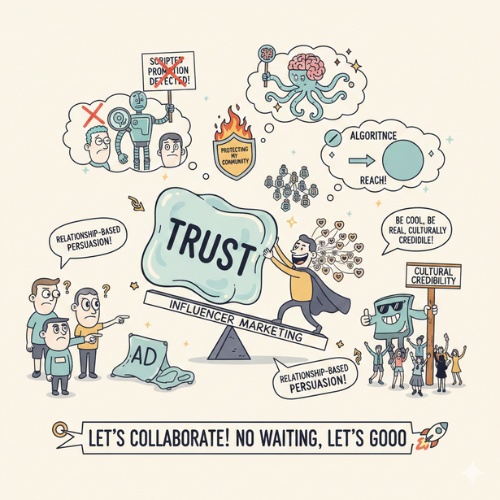
Influencer marketing works because people trust people more than ads. However, trust is fragile.

Several shifts have changed how collaborations must be designed:

  • Audiences recognise scripted promotions instantly
  • Creators protect their communities more fiercely
  • Algorithms prioritise relevance over reach
  • Brand differentiation requires cultural credibility

Learning how to collaborate with influencers today means understanding influence as relationship-based persuasion, not amplified messaging. 

Let’s not wait and see how to collaborate with them

How to collaborate with influencers: A Complete Guide

Step 1: Define the Purpose of the Collaboration
Purpose of the Collaboration

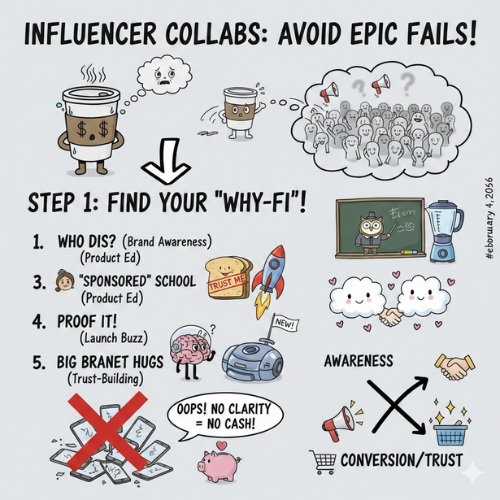
Before identifying influencers, brands must define why the collaboration exists.

Common objectives include:

  • Brand awareness within a specific community
  • Product education or category explanation
  • Social proof during launches
  • Consideration support for high-involvement products
  • Community trust-building over time

Campaigns fail most often when brands skip this step and optimise for visibility without clarity.

A collaboration built for awareness looks very different from one built for conversion or trust.

Step 2: Identify the Right Type of Influencer
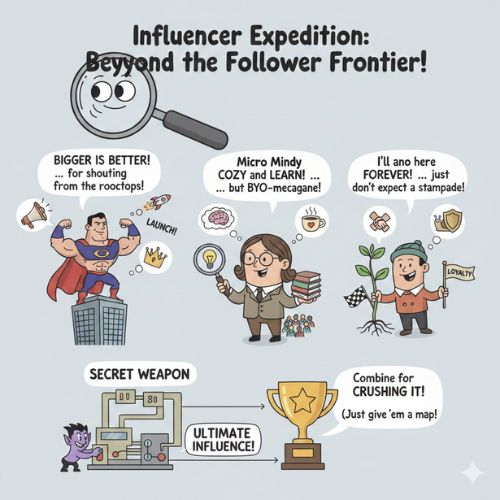
Identify the Right Type of Influencer

Follower count is not a strategy.

Influencers fall into functional categories based on their role, not their size.

Macro Influencers

  • Strength: Reach and cultural visibility
  • Best for: Awareness, positioning, launches
  • Limitation: Lower perceived intimacy

Micro Influencers

  • Strength: Engagement depth and trust
  • Best for: Consideration, education, niche products
  • Limitation: Limited scale individually

Nano Influencers

  • Strength: High relevance and authority
  • Best for: Long-term partnerships, advocacy
  • Limitation: Slower reach expansion

The strongest influencer programs combine multiple tiers, assigning each creator a clear role.

Step 3: Evaluate Influencers Beyond Surface Metrics
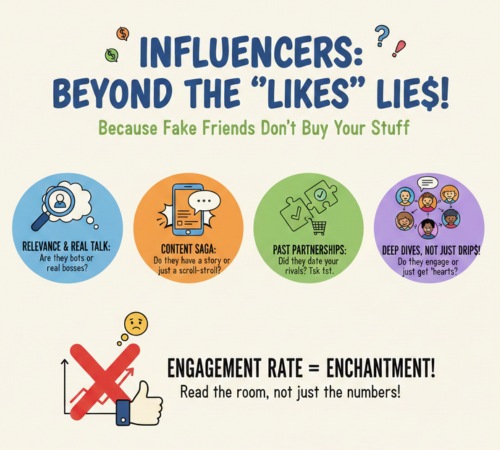
Evaluate Influencers Beyond Surface Metrics

To collaborate effectively, brands must evaluate influence quality, not popularity.

Key evaluation signals include:

  • Audience relevance and comment authenticity
  • Content consistency and storytelling ability
  • Past brand alignment
  • Depth of audience interaction, not just volume

Engagement rate alone is insufficient without a qualitative review.

Look at how audiences respond, not just how often.

Step 4: Build a Collaboration Pitch That Influencers Respect

Build a Collaboration Pitch That Influencers Respect

Creators receive hundreds of brand emails. Most are ignored.

A strong influencer collaboration pitch includes:

  • Clear explanation of why the creator was chosen
  • Understanding of their content style and audience
  • Defined collaboration scope without creative restriction
  • Transparent expectations around deliverables and timelines

Avoid templated outreach. Respect the creator’s creative intelligence.

Step 5: Choose the Right Collaboration Model
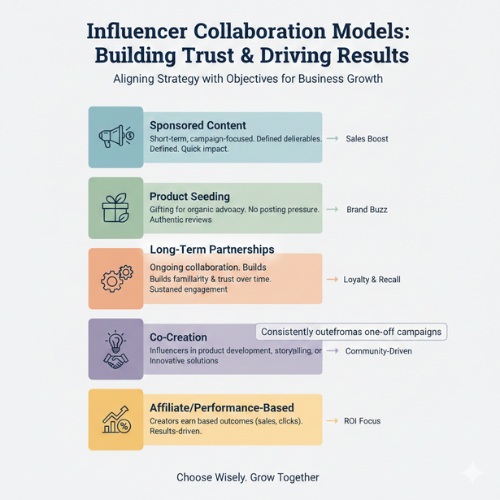
Choose the Right Collaboration Model

There is no single way to collaborate with influencers. The model should match the objective.

Sponsored Content

Short-term, campaign-focused content with defined deliverables.

Product Seeding

Gifting without posting pressure is often used for organic advocacy.

Long-Term Partnerships

Ongoing collaboration that builds familiarity and trust over time.

Co-Creation

Influencers participate in product development, storytelling, or campaigns.

Affiliate or Performance-Based Models

Creators earn based on outcomes rather than fixed fees.

Long-term partnerships consistently outperform one-off campaigns in trust and recall.

Step 6: Co-Create Content, Do Not Control It

Co-Create Content, Do Not Control It

Creators understand their audiences better than brands do.

Effective influencer collaboration allows:

  • Creative flexibility within brand guardrails
  • Platform-native storytelling
  • Honest opinions rather than forced endorsements

Overly scripted content signals advertising instantly.

 Audiences respond better to creator-led narratives than brand-led messaging.

Step 7: Align Platforms With Collaboration Goals
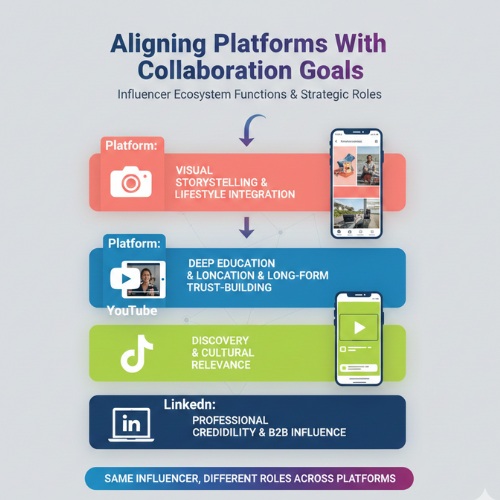
Align Platforms With Collaboration Goals

Each platform serves a different function in the influencer ecosystem.

  • Instagram supports visual storytelling and lifestyle integration
  • YouTube enables deep education and long-form trust-building
  • TikTok excels at discovery and cultural relevance
  • LinkedIn supports professional credibility and B2B influence

The same influencer may play different roles across platforms.

Step 8: Set Clear Collaboration Guidelines

Set Clear Collaboration Guidelines

Clarity protects both brands and creators.

Collaboration guidelines should cover:

  • Brand values and non-negotiables
  • Disclosure requirements
  • Content usage rights
  • Approval workflows
  • Performance expectations

Transparency prevents misalignment and protects long-term relationships.

Step 9: Measure What Matters
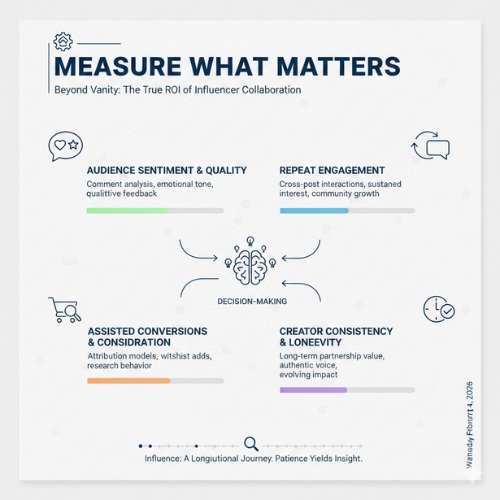
Vanity metrics distort decision-making. Effective influencer collaboration measurement includes:

  • Audience sentiment and comment quality
  • Repeat engagement across posts
  • Assisted conversions and consideration signals
  • Creator consistency over time

 Influence often supports decisions rather than directly driving them. This requires patience and longitudinal analysis.

Step 10: Turn Campaigns Into Systems

Turn Campaigns Into Systems

The most successful brands do not run influencer campaigns. They build influencer ecosystems.

This includes:

  • Creator databases and relationship management
  • Performance learning loops
  • Long-term collaboration pipelines
  • Strategic creator retention

When influencer collaboration becomes a system, results compound.

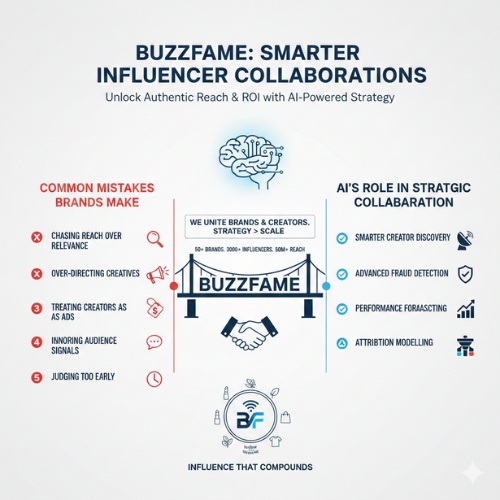
Common Mistakes Brands Make When Collaborating With Influencers

Many influencer collaborations underperform not because of poor creators, but because of flawed expectations and execution.

Common missteps include:

  • Chasing reach instead of relevance, resulting in visibility without meaningful audience connection.
  • Over-directing creative output, which strips content of the creator’s voice and weakens authenticity.
  • Treating creators as ad placements, rather than as partners with cultural and community insight.
  • Ignoring audience signals, such as comments, sentiment, and conversation quality, that reveal real impact.
  • Judging performance too early, before influence has time to translate into consideration or action.

Avoiding these mistakes often produces stronger results than increasing influencer volume or spend.

The Role of AI in Influencer Collaboration

AI has become a critical support layer in modern influencer collaboration, helping brands operate with greater precision and confidence.

Today, AI enables:

  • Smarter creator discovery, using audience behaviour, content patterns, and relevance scoring rather than surface metrics.
  • Advanced fraud detection, identifying inflated followers and artificial engagement before partnerships begin.
  • Performance forecasting allowing brands to anticipate reach, engagement quality, and potential impact prior to launch.
  • Attribution modelling, connecting influencer activity to assisted and long-term outcomes across channels.

However, AI does not replace human judgment. Cultural understanding, creative nuance, and relationship-building remain human responsibilities.

Technology enables scale. Strategy determines success.

BuzzFame: Uniting Influencers and Brands Through Strategic Collaboration
BuzzFame Collaboration

BuzzFame exists to bridge the gap between brands seeking meaningful influence and creators building genuine communities. Rather than functioning as a transactional marketplace, BuzzFame operates as a strategic partner that aligns brand intent with creator authenticity.

As the best influencer marketing agency in India, we have united 50+ leading brands with 3,000+ carefully vetted influencers across beauty, wellness, lifestyle, fashion, and emerging niches, generating over 50 million reach across platforms.

Every collaboration is built on relevance, not reach. By combining audience intelligence, creator insight, and performance measurement, we ensure brands and influencers grow together, creating influence that compounds beyond campaigns.

Influencer Collaboration Is a Relationship, Not a Transaction

Learning how to collaborate with influencers is ultimately about understanding influence as a human system.

The brands that succeed:

  • Respect creators as partners
  • Invest in long-term trust
  • Design collaboration with intention
  • Measure impact beyond immediacy

Influencer marketing is not becoming less human. It is becoming more accountable.

FAQs Related To How To Collaborate With Influencers

1. How do brands collaborate with influencers?

Brands collaborate with influencers by identifying relevant creators, aligning objectives, co-creating content, setting clear expectations, and measuring performance based on engagement, trust, and business outcomes.

2. What is the best way to approach influencers?

The best approach is personalised outreach that explains why the creator is a fit, respects their creative voice, and clearly outlines collaboration goals without rigid control.

3. Do influencer collaborations work for small brands?

Yes. Small brands often benefit most by collaborating with micro and niche influencers who have strong community trust and higher engagement relevance.

4. How much should brands pay influencers?

Compensation depends on audience size, engagement quality, content format, usage rights, and collaboration scope. There is no universal rate card.

5. Are long-term influencer collaborations better?

Long-term collaborations generally build stronger trust, better recall, and more consistent performance compared to one-off sponsored posts.

6. What platforms are best for influencer collaboration?

The best platform depends on goals. Instagram and TikTok support discovery, YouTube builds trust, and LinkedIn works for professional or B2B influence.

7. How do you measure influencer collaboration success?

Success is measured through engagement quality, sentiment, assisted conversions, brand lift, and long-term audience interaction rather than likes alone.

8. Can influencer collaborations drive sales?

Yes, but often indirectly. Influencer collaborations support consideration and confidence, contributing to assisted rather than immediate conversions.

9. What mistakes should brands avoid in influencer collaboration?

Brands should avoid over-scripting content, choosing influencers based only on follower count, and treating collaborations as purely transactional.

10. How should brands start collaborating with influencers?

Brands should start by defining clear goals, identifying relevant creators, testing small partnerships, and building relationships before scaling.

AI in Influencer Marketing: Key Trends, Tools, and Strategies

Influencer marketing is evolving from reach-driven campaigns to relevance-led systems, with AI acting as the connective intelligence behind this shift. In 2026, AI supports smarter creator discovery, deeper audience understanding, trust-based measurement, and social commerce without replacing human creativity. The most effective strategies position AI in influencer marketing as infrastructure that strengthens relevance, consistency, and long-term influence rather than short-term visibility.

Why AI in Influencer Marketing Is Redefining Influence Itself

AI in Influencer Marketing Is Redefining Influence Itself

Influencer marketing has reached a point of saturation. Every platform is crowded, every feed looks familiar, and attention has become the most expensive currency in digital marketing. At the same time, brands are expected to do more with tighter budgets, fragmented audiences, and increasing pressure to prove impact.

This is where AI in influencer marketing enters the conversation, not as a trend, but as structural infrastructure.

AI is no longer limited to automation or efficiency. It now influences how creators are discovered, how content is shaped, how audiences are segmented, and how influence is measured over time. Yet the most important shift is not technological. It is philosophical.

AI is forcing brands to rethink influence not as reach, but as relevance. Not as campaigns, but as systems. And not as creator output, but as audience trust built across repeated interactions.

Understanding AI in Influencer Marketing Today

From Automation to Intelligence

In its early stages, AI in influencer marketing was primarily operational. Tools focused on reducing manual effort by automating influencer discovery, basic reporting, and scheduling. The value proposition was speed.

In 2026, the role of AI is fundamentally different. It now operates as a decision-support layer, analysing behavioural patterns, predicting outcomes, and identifying signals humans cannot process at scale. The focus has shifted from doing things faster to doing the right things more consistently.

Why This Shift Matters Now

Several structural changes have made AI essential rather than optional.

Audiences no longer move linearly through platforms. Privacy-first updates have reduced visibility into user journeys. Content consumption has become fragmented across formats, communities, and devices.

AI in influencer marketing addresses this complexity by connecting patterns rather than tracking individuals. It enables brands to adapt to uncertainty instead of fighting it.

Key Trends in AI in Influencer Marketing (2026)

Human–AI Collaboration Becomes the Default Model

The most important trend is not replacement, but collaboration.

AI handles scale, pattern recognition, and optimisation. Humans handle storytelling, cultural nuance, and emotional context. The most effective influencer programs treat AI as a creative co-pilot rather than a creative authority.

This balance allows creators to spend less time on operational tasks and more time on content that feels human, specific, and emotionally resonant.

Virtual Influencers and AI Avatars Becoming More Strategic

Virtual influencers are no longer experimental novelties. AI now enables brands to create digital personas that are always available, fully brand-aligned, and scalable across markets.

These avatars work best in storytelling, fashion, tech, and immersive brand experiences. However, they rarely replace human creators. Instead, they operate alongside them, extending narratives while real creators anchor credibility.

Hyper-Personalisation Across Fragmented Platforms

AI in influencer marketing enables personalisation beyond demographics.

Content can now be tailored based on interests, behaviour patterns, platform context, and consumption habits. This allows brands to move away from one-size-fits-all influencer posts and toward adaptive narratives that feel native to each audience segment.

Social Commerce is Becoming More Native

AI is powering seamless transitions from content to commerce. Shoppable posts, live shopping, and creator-led product discovery are increasingly driven by predictive models that identify purchase readiness.

Influencer content no longer introduces products. It now supports decisions.

Edutainment and Purpose-Driven Influence

Audiences increasingly reward content that teaches, explains, or adds context. AI helps creators analyse what their communities actually want to learn, not just what performs well superficially.

This shift strengthens community-based influence rather than trend-driven virality.

AI Tools Powering Influencer Marketing

Why Tool Stacks Matter More Than Single Platforms?

No single AI tool can manage the entire influencer lifecycle. Effective programs use modular stacks where discovery, creation, measurement, and optimisation work together without forcing uniformity.

AI Tools in Influencer Marketing

Tool Name Primary Function Platform Strength Key Capabilities Best For
Upfluence AI-powered influencer discovery and campaign management Strong integration with online stores and sales funnels Smart influencer matching, e-commerce integrations, performance tracking, CRM features E-commerce & DTC brands needing full funnel influencer workflows
Influencity End-to-end influencer marketing platform Scalable influencer operations with deep audience intelligence Large influencer database, AI audience insights, fraud detection, campaign analytics Mid-to-large brands seeking scalable influencer programs
Sprout Social Unified influencer and social management Combines influencer marketing with social media analytics AI-powered creator discovery, performance tracking, reporting integration with social platforms Social media teams want data-first influencer planning
Brandwatch Consumer intelligence + influencer insights Deep audience listening and cultural insight Sentiment analysis, real-time analytics, influencer match scoring Enterprises needing deeper audience context
HypeAuditor Influencer analytics & authenticity toolkit Strong credibility and safety validation AI fraud detection, audience quality analysis, performance benchmarking Brands focused on credibility and safety
AspireIQ Influencer relationship and campaign platform Relationship-driven influencer collaboration Automated outreach, content performance suggestions, and ROI dashboards Brands prioritising creator collaboration and optimisation
Traackr Influencer vetting & spend optimisation Budget optimisation and compliance at scale AI influencer vetting, global creator database, campaign ROI tracking Large-scale and enterprise influencer campaigns
Modash Creator discovery & audience insights Precision targeting across regions and niches Deep audience data, verified reach filters, cross-platform analytics Precision discovery for multi-region/niche targeting
CreatorIQ Enterprise influencer marketing intelligence Governance, compliance, and enterprise-level reporting AI-driven discovery, performance analytics, alignment scoring Enterprise brands need governance and measurement
Klear Data-driven influencer analytics Analytical view of influencer impact AI-powered influencer analytics, campaign tracking, and performance reporting Brands & agencies seeking analytical influence insights

Strategies for Using AI in Influencer Marketing

Strategy 1: Designing Hybrid Creator Ecosystems

Single-tier influencer strategies struggle because they optimise for one outcome.

AI enables layered creator ecosystems where:

  • Macro creators provide visibility
  • Micro creators build trust
  • Niche creators anchor community relevance

AI assists in role assignment, ensuring each creator contributes where they are strongest.

Strategy 2: Data-Driven Personalisation Without Losing Humanity

AI enables personalisation at scale, but personalisation without empathy feels mechanical.

The most effective brands use AI to understand context, not to manufacture emotion. Content is adjusted for format and audience, but stories remain creator-led.

Strategy 3: Using AI as a Trust Accelerator

AI in influencer marketing identifies credibility patterns by analysing consistency, audience behaviour, and historical alignment.

This shifts creator selection from popularity-based decisions to trust-based partnerships. Long-term collaborations emerge naturally from this approach.

Strategy 4: AI-Enabled Social Commerce Funnels

AI shortens the distance between discovery and decision by identifying high-intent moments.

Instead of pushing conversions, influencer content supports confidence. AI helps brands understand when influence assists a sale rather than closes it.

Strategy 5: Building Integrated Human-AI Campaign Systems

The strongest programs design workflows where AI supports each stage without controlling it.

Discovery, content, distribution, and measurement are connected, but humans retain creative authority.

Strategy 6: Measuring Real Impact

AI shifts ROI measurement from isolated metrics to influence over time.

Brands increasingly track:

  • Repeat engagement
  • Assisted conversions
  • Community growth
  • Lifetime value

This reframes success from immediate spikes to sustained influence.

Risks and Limitations of AI in Influencer Marketing

AI brings efficiency and scale to influencer marketing, but its limitations must be acknowledged to avoid strategic blind spots.

Key risks include:

  • Algorithmic bias in training data can repeatedly surface similar creator profiles and unintentionally limit diversity, regional voices, or emerging niches.
  • Excessive automation, where reliance on AI outputs can flatten creativity, producing content that feels optimised but culturally hollow.
  • Dependence on fragmented platform data, as AI insights are only as strong as the signals platforms allow brands to access.
  • Transparency and disclosure challenges, particularly around AI-assisted or AI-generated content, which can affect audience trust and regulatory compliance.

AI should enhance human judgment, not override it. Strategy must always guide technology, not the other way around.

AI in Influencer Marketing With Strategic Clarity

Influencer Marketing at BuzzFame is fun and strategic. We love exploring and implementing different designs and hop onto the trends that make content work. We don’t only want to influence, our focus is on creating a community that comes back again and again and again. AI supports our discovery, performance intelligence, and measurement, while creators remain the cultural engine of influence. As the best influencer marketing agency in India, we have partnered with over 50 leading brands, activated 3,000+ influencers across beauty, wellness, lifestyle, and emerging niches, and driven over 50 million reach across platforms.

The Future of AI in Influencer Marketing Is Human-Led

AI is not changing influencer marketing by making it colder or more mechanical. It is changing it by forcing clarity.

  • Clarity about who influences whom.
  • Clarity about why content works.
  • Clarity about what impact actually means.

The brands that win will not be the ones that automate fastest, but the ones that combine intelligence with intention.

FAQs Related To Ai In Influencer Marketing

1. What is AI in influencer marketing?

AI in influencer marketing refers to using machine learning and data analysis to improve creator discovery, content optimisation, performance prediction, fraud detection, and ROI measurement across influencer campaigns.

2. How does AI improve influencer discovery?

AI analyses audience behaviour, content patterns, and engagement quality to identify creators aligned with brand values, not just follower count or surface-level metrics.

3. Can AI replace human influencers?

AI does not replace human influencers. It supports them by handling repetitive tasks, insights, and optimisation, while creators focus on storytelling and community connection.

4. What role do virtual influencers play?

Virtual influencers support scalable storytelling and brand consistency. They work best alongside human creators who provide authenticity and emotional grounding.

5. How does AI help measure influencer ROI?

AI enables multi-touch attribution, identifies assisted conversions, and analyses delayed impact, offering a more realistic view of influencer-driven value.

6. Is AI influencer marketing suitable for small brands?

Yes. AI helps small brands optimise budgets, identify high-fit micro creators, and avoid inefficient partnerships through better decision-making.

7. What are the risks of AI in influencer marketing?

Risks include bias, over-automation, data dependency, and reduced creative diversity if AI outputs are followed without strategic oversight.

8. How does AI support social commerce?

AI identifies purchase-ready moments, optimises shoppable content, and connects influencer engagement with assisted and direct sales.

9. Will AI make influencer marketing less authentic?

Only if misused. When applied strategically, AI enhances authenticity by supporting better creator-audience alignment and long-term partnerships.

10. How should brands start using AI in influencer marketing?

Brands should begin by using AI for insights and optimisation while keeping creators and strategy at the centre of decision-making.

How AI Is Changing Influencer Marketing

Influencer marketing has always been about people, trust, and relevance. What has changed is the scale, complexity, and expectation placed on it. As creator ecosystems expand and platforms fragment, intuition alone is no longer enough. This is where artificial intelligence enters the picture.

Understanding how AI is changing influencer marketing requires moving beyond surface-level automation. AI is not simply making influencer campaigns faster. It is reshaping how creators are discovered, how campaigns are planned, how performance is measured, and how influence itself is defined.

This shift is not futuristic. It is already underway.

How Influencer Marketing Advanced

How Influencer Marketing Advanced

Influencer marketing did not become complex overnight. It evolved as platforms multiplied, creators diversified, and audiences became more selective. What

once involved shortlists and manual outreach now spans thousands of creators across formats, regions, and niches.

Brands reached a point where discovery became so overwhelming because almost everyone was on social media, and measurement became hard. AI did not enter influencer marketing as a trend. It entered as a necessity.

To understand how AI is changing influencer marketing, it helps to see it not as a replacement for creativity, but as infrastructure. AI brings structure to an ecosystem that grew faster than traditional marketing systems could manage.

Why AI Is Needed For Influencer Marketing

Why AI Is Needed For Influencer Marketing

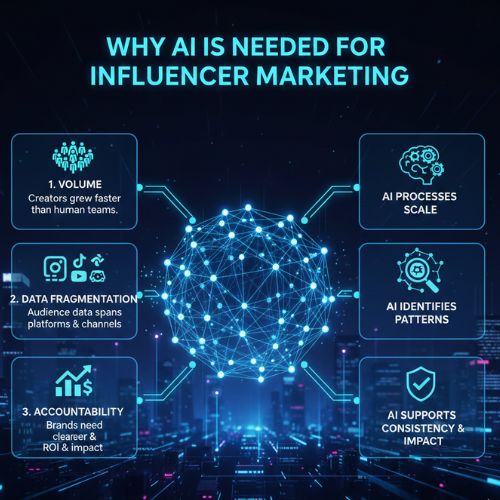
Influencer marketing faced three structural challenges.

First, volume. The number of creators grew faster than human teams could evaluate them meaningfully.

Second, data fragmentation. Audience behaviour spans platforms, formats, and private channels that do not connect cleanly.

Third, accountability. As budgets increased, brands needed clearer answers around performance and impact.

AI addresses these gaps by processing scale, identifying patterns, and supporting consistency where manual effort falls short.

How AI Is Changing Influencer Discovery and Matching

Influencer discovery is where AI’s impact is most immediately visible.

Traditionally, discovery was heavily dependent on hashtags, follower counts, and manual shortlisting

AI shifts discovery toward audience intelligence and alignment.

How AI improves discovery

  • Analyses audience demographics, interests, and behaviour patterns
  • Identifies audience overlap between creators and brands
  • Evaluates tone, content themes, and brand safety signals
  • Surfaces creators who align culturally, not just numerically

This means influencer selection becomes less about popularity and more about relevance.

AI does not decide partnerships on its own. It narrows the field intelligently, allowing human teams to make better final decisions.

The more ways AI is revolutionising Influencer marketing are

Predictive Analytics: Planning Before Launch, Not After

One of the most significant ways AI is changing influencer marketing is through prediction.

Instead of asking, “How did this perform?”, brands can now ask, “How is this likely to perform?”

AI models can forecast:

  • Estimated reach and engagement
  • Audience response likelihood
  • Conversion probability based on historical patterns
  • Budget efficiency across creators

This allows brands to plan strategically, allocate budgets more responsibly, and reduce performance uncertainty before campaigns go live.

AI-Powered Fraud Detection and Trust Building

Influencer fraud is not always obvious. Fake followers, engagement pods, and inflated metrics often appear legitimate. When this happens to trust becomes very difficult.

AI improves trust by:

  • Detecting unnatural engagement patterns
  • Identifying follower growth anomalies
  • Flagging bot-driven interactions
  • Analysing consistency across content history

This protects brands from misallocation and helps genuine creators maintain credibility. In this way, AI strengthens the ecosystem rather than policing it.

Content Creation and Optimisation

AI supports creativity the best. Creators and brands now use AI tools to:

  • Analyse content performance patterns
  • Generate content ideas aligned with audience interest
  • Optimise captions and posting times
  • Support video editing and formatting

By handling repetitive or analytical tasks, AI frees creators to focus on storytelling, authenticity, and originality.

Real-Time Campaign Monitoring and Optimisation

Influencer campaigns are no longer static; they move and also create the hype – the one everyone loves.

AI enables:

  • Live performance tracking across platforms
  • Identification of content momentum or drop-offs
  • Mid-campaign optimisation of spend or formats
  • Faster response to audience feedback

Automating Influencer Marketing Operations

One feature of AI loved by everyone is its ability to automate. It completely automates

  • Influencer outreach and communication
  • Contract generation and compliance tracking
  • Payment processing and scheduling
  • Performance reporting and documentation

This allows brands to manage large influencer programs without losing control or transparency.

Personalisation Through AI

AI can and does even personalise the entire content for influencers

AI enables:

  • Content personalisation by region, interest, or behaviour
  • Segment-specific messaging 
  • More meaningful engagement at scale

What was already more personal becomes more personal with AI.

The Rise of Virtual Influencers

Virtual influencers represent one of the most visible outcomes of AI in influencer marketing.

AI-powered virtual creators offer:

  • Complete brand control
  • Consistent tone and availability
  • Cross-platform scalability
  • Integration into gaming, AR, and immersive environments

However, virtual influencers work best when they complement human voices. Without emotional grounding, trust remains limited.

How AI Is Changing Influencer Marketing ROI Measurement

Measuring influencer marketing ROI has never been an easy task because influence never drive linear traffic. To simplify the process, AI brings clarity by interpreting the complexity and making the data understandable.

AI-powered systems enhance ROI measurement by:

  • Supporting multi-touch attribution models that distribute value across the entire customer journey
  • Identifying assisted conversions where influencer exposure influenced consideration, not just the final click
  • Analysing behavioural patterns such as repeat visits, content saves, and delayed purchase intent
  • Connecting on-platform engagement with off-platform actions like search behaviour and website interaction

The outcome is not artificially neat reporting, but a more accurate and defensible understanding of how influence contributes to real business results.

Risks and Limitations of AI in Influencer Marketing

AI introduces scale and efficiency, but it does not eliminate strategic responsibility. Its limitations become visible when technology is treated as a substitute for judgment rather than a support system.

Key risks brands must account for include:

  • Bias in training data, which can reinforce narrow creator selection or exclude emerging voices
  • Over-automation, where optimisation prioritises performance patterns at the cost of originality and creative nuance
  • Transparency and disclosure challenges, especially around AI-generated content and regulatory compliance
  • Dependence on platform data quality, where incomplete or restricted data can skew AI-driven insights

AI should inform decisions, not dictate them. Strategy must always lead, with technology serving as an enabler rather than the driver.

Wondering about the trends, Tools, and Strategies to use AI, read this to know more: AI in Influencer Marketing: Key Trends, Tools, and Strategies

BuzzFame: How AI-Driven Influence Is Built Strategically

At BuzzFame, we treat AI as an assistant. As the best influencer marketing agency in India, with partnerships across 50+ brands, a network of 3,000+ influencers spanning beauty, wellness, lifestyle, and beyond, and over 50 million cumulative reach, we apply intelligence where it matters most. Here, Influencer campaigns are built through audience relevance, content credibility, funnel alignment, and measurable impact. AI enhances decision-making, while creators anchor trust. This balance ensures that we deliver you long-term value.

Influencer marketing has evolved from a trend into a multimillion-dollar industry reshaping brand strategy worldwide.

Embrace The Intelligence

Understanding how AI is changing influencer marketing means recognising that influence is evolving and realising you need to catch up with it.

AI brings structure to creativity. It introduces accountability without stripping authenticity. The brands and creators who succeed will be those who treat AI as a partner in intelligence, not a replacement for human connection.

Frequently Asked Questions

How is AI changing influencer marketing today?

AI is changing influencer marketing by improving creator discovery, predicting performance, detecting fraud, optimising content, automating operations, and enabling better ROI measurement across complex customer journeys.

Can AI replace human influencers?

AI cannot replace human influencers entirely. Influence relies on emotion, trust, and lived experience. AI functions best as a co-pilot that supports creators rather than replacing them.

How does AI help in influencer discovery?

AI analyses audience demographics, interests, engagement behaviour, and content patterns to match brands with creators more accurately than manual methods or follower-based selection.

Is AI useful for small influencer campaigns?

Yes. AI helps small campaigns optimise budgets, reduce risk, and identify high-fit creators, making influencer marketing more efficient even at a limited scale.

How does AI detect fake influencers?

AI detects fraud by identifying abnormal engagement patterns, suspicious follower growth, bot activity, and inconsistencies between audience behaviour and reported metrics.

Are virtual influencers powered by AI effective?

Virtual influencers powered by AI are effective for controlled storytelling and scalable campaigns, but they work best when paired with human creators for authenticity.

How does AI improve influencer marketing ROI?

AI supports multi-touch attribution, assisted conversion tracking, predictive analytics, and behavioural analysis, offering a more realistic understanding of influencer impact.

What risks come with AI in influencer marketing?

Risks include over-automation, biased datasets, reduced creative nuance, and transparency challenges. Strategic oversight remains essential.

Will AI make influencer marketing less authentic?

AI does not reduce authenticity when used correctly. It removes inefficiencies while allowing creators to focus more deeply on storytelling and community engagement.

Is AI essential for influencer marketing in the future?

AI is becoming essential due to scale, complexity, and accountability demands. Brands that integrate AI thoughtfully will gain long-term competitive advantage.

Top Influencer Marketing Trends To Watch In 2026

Why Influencer Marketing Looks Different Heading into 2026

Influencer marketing has reached a point of maturity. What began as experimental brand endorsements has evolved into a core marketing discipline with clear expectations, accountability, and structure. As budgets grow, so does scrutiny.

Audiences are more media-literate. Platforms are more algorithmically complex. Brands are under pressure to justify spend. Together, these forces are reshaping influencer marketing trends in fundamental ways.

In 2026, influence is no longer about being seen everywhere. It is about being trusted somewhere. This shift underpins every major influencer marketing trend emerging today.

The Structural Shift Behind Influencer Marketing Trends 2026

Influencer Marketing Trends

To understand influencer marketing trends in 2026, it is essential to understand why the ecosystem is changing.

Platforms have moved away from rewarding raw reach. Algorithms increasingly prioritise watch time, saves, comments, and meaningful interaction. Audiences, in turn, reward creators who offer consistency, expertise, and relevance rather than constant promotion.

At the same time, social consumption has fragmented. People no longer gather around mass trends. They form interest-based clusters, follow fewer creators more closely, and engage in smaller but deeper communities.

This structural shift explains why influence in 2026 is less about scale and more about significance.

Now, let’s look up the trends that are going to rock in 2026.

Influencer Marketing Trends in 2026

Influencer Marketing Trends

Trend 1: Micro-Communities Driving Macro Impact

One of the most defining influencer marketing trends is the rise of micro-communities.

Instead of targeting millions of passive viewers, brands are finding greater value in creators who speak to clearly defined audiences. These communities are built around shared interests, professions, lifestyles, or cultural identities.

Micro-communities offer:

  • Higher engagement density
  • Stronger trust signals
  • More relevant conversations
  • Better conversion efficiency

This influencer marketing trend reflects a deeper truth. People trust voices that understand their context. In 2026, relevance consistently outperforms reach.

Trend 2: Long-Term Creator Partnerships Replace One-Off Campaigns

Transactional collaborations are losing effectiveness. Audiences can easily spot one-off promotions that lack continuity or genuine usage.

One of the most important influencer marketing trends in 2026 is the shift toward long-term creator partnerships. Brands are increasingly working with fewer creators over longer periods.

These partnerships allow:

  • Trust to compound over time
  • Messaging to evolve naturally
  • Creators to speak from experience rather than scripts

Influencer marketing becomes less about campaign spikes and more about sustained presence within communities.

Trend 3: Outcome-Based Influencer Marketing Becomes Standard

As influencer budgets grow, accountability follows.

Brands are no longer satisfied with impressions alone. A key influencer marketing trend in 2026 is the move toward outcome-based collaboration models.

This includes:

  • Performance-linked compensation
  • Clear success metrics aligned with funnel stages
  • ROI-focused evaluation frameworks

Importantly, outcome-based does not mean creativity is sacrificed. Instead, it aligns creative freedom with business intent.

Trend 4: Influencer Marketing Becomes Funnel-Integrated

One of the most overlooked influencer marketing trends is funnel integration.

Influencers are no longer confined to top-of-funnel awareness. In 2026, creators play roles across the entire buyer journey.

  • Awareness: Discovery, recall, and interest creation
  • Consideration: Education, validation, and trust-building
  • Conversion: Offers, demonstrations, and urgency
  • Retention: Advocacy, repeat usage, and community reinforcement

This integration allows influencer marketing to support performance channels rather than compete with them.

Trend 5: Virtual Influencers and AI-Assisted Creators Find Their Place

Virtual influencers and AI-assisted creators are not replacing humans. They are complementing them.

One of the more nuanced influencer marketing trends in 2026 is the selective use of virtual personas for consistency, storytelling, and scalability.

Virtual influencers work best when:

  • Supporting long-term brand narratives
  • Appearing in controlled environments
  • Complementing human creators rather than replacing them

Human trust remains irreplaceable. Virtual scalability fills gaps where consistency and control matter.

Trend 6: Creator-Led Content Becomes Performance Media

Influencer content is no longer limited to organic posts.

A major influencer marketing trend is the repurposing of creator content into paid media. Brands are increasingly using influencer-led creatives across ads, landing pages, and retargeting funnels.

Why this works:

  • Creator content feels native
  • Audiences respond better to familiar faces
  • Performance often exceeds brand-produced ads

The line between influencer marketing and performance marketing continues to blur.

Trend 7: Decentralisation Across Platforms

Influencer marketing in 2026 is platform-agnostic.

Relying on a single platform introduces risk. Algorithms change. Reach fluctuates. Audiences migrate.

One of the key influencer marketing trends is decentralisation:

  • Expansion beyond Instagram and YouTube
  • Growth of private communities and newsletters
  • Niche platforms are gaining influence

Brands that diversify their influencer presence build resilience.

Trend 8: Trust, Transparency, and Creator Credibility

Trust is the currency of influence.

Audiences scrutinise partnerships more than ever. One of the strongest influencer marketing trends in 2026 is the rise of selective promotion.

Creators are:

  • Partnering with fewer brands
  • Demanding alignment with values
  • Protecting audience trust

For brands, credibility is no longer optional. It is foundational.

Trend 9: Data-Driven Influencer Selection Replaces Gut Instinct

Follower counts are losing relevance.

Brands are adopting behaviour-based selection models as part of evolving influencer marketing trends. This includes evaluating:

  • Engagement quality
  • Audience relevance
  • Content consistency
  • Historical performance

Data does not replace intuition. It refines it.

Trend 10: Community Ownership Over Algorithm Dependency

The most strategic influencer marketing trend of 2026 is community ownership.

Brands are recognising the value of creators who build owned audiences rather than rely solely on algorithms. These communities provide:

  • Stability
  • Direct communication
  • Long-term brand equity

Influence that exists beyond platforms is influence that endures.

What These Influencer Marketing Trends Mean for Brands

Taken together, these influencer marketing trends reflect a structural shift in how influence is created, distributed, and measured. The implications for brands are clear and non-negotiable.

Brands must stop:

  • Chasing reach without relevance
    Scale without contextual fit, trust, or audience alignment delivers visibility, not impact.
  • Measuring influence in isolation
    Evaluating influencers as standalone performers ignores their role in discovery, validation, and recall across the buyer journey.
  • Treating creators as media placements
    Creators are not ad inventory. They shape perception, culture, and long-term brand memory.

Instead, brands must:

  • Build systems, not campaigns
    Influence should be embedded into ongoing brand ecosystems, not activated only during launches or peak moments.
  • Invest in relationships, not spikes
    Long-term creator partnerships compound trust and consistently outperform one-off activations.
  • Measure influence across time, not moments
    The real value lies in sustained relevance, repeat exposure, and cumulative credibility, not just immediate clicks or conversions.

In 2026, winning brands will treat influencer marketing as infrastructure rather than a tactic. Those who adapt to this mindset shift will build influence that lasts, scales, and delivers durable business outcomes.

BuzzFame: Navigating Influencer Marketing Trends with Strategic Clarity

At BuzzFame, influencer marketing trends are interpreted as long-term signals, not short-term growth hacks. Positioned as the best influencer marketing agency in India, BuzzFame operates at the intersection of data, creativity, and community to build influencer ecosystems aligned with real business objectives. 

  • With partnerships spanning 50+ brands
  • A network of 3,000+ influencers across niches such as beauty, well-being, and lifestyle
  • A cumulative 50+ million reach across platforms,
  • Explore our works

The focus remains on relevance over virality. Every collaboration is evaluated through audience alignment, content credibility, funnel relevance, and measurable impact, enabling brands to adapt to evolving influencer marketing trends without compromising authenticity or long-term value.

Influence in 2026 Is Earned, Not Amplified

Influencer marketing in 2026 is not driven by amplification alone. It is earned through relevance, consistency, and trust.

The brands that succeed will be those that understand influencer marketing trends as reflections of audience behaviour, not marketing fads. Influence, when built thoughtfully, compounds.

Those who adapt will not just keep up. They will lead. Which one do you want to be?

FAQs Related to Influencer Marketing Trends To Watch In 2026

What are the most important influencer marketing trends to watch in 2026?

Influencer marketing trends in 2026 point toward deeper creator-brand relationships, community-driven influence, outcome-based measurement, and niche relevance over mass reach. Brands are moving away from one-off campaigns toward always-on ecosystems. Data, authenticity, and long-term value creation are becoming more important than short-term visibility or viral moments.

Why are micro and niche influencers gaining importance in 2026?

Micro and niche influencers deliver stronger trust, contextual relevance, and higher engagement within specific communities. In 2026, brands value influence that shapes decisions, not just exposure. These creators often drive better consideration and recall, making them more effective for long-term brand growth than large-scale, low-relevance reach.

How is influencer marketing ROI measurement changing in 2026?

ROI measurement is shifting from surface metrics to outcome-focused evaluation. Brands now assess influence across the full funnel, including awareness, consideration, assisted conversions, and retention. Multi-touch attribution and qualitative signals such as brand lift and recall are increasingly used to reflect how influence actually works.

Are vanity metrics still relevant in influencer marketing trends 2026?

Vanity metrics like likes and views are not useless, but they are no longer sufficient alone. In 2026, they serve as contextual indicators rather than success benchmarks. Brands use them alongside engagement quality, traffic behaviour, and conversion signals to understand influence depth instead of chasing inflated numbers.

How are creator-brand relationships evolving in 2026?

Creators are no longer treated as media placements. Influencer marketing trends in 2026 emphasise partnerships built on trust, consistency, and shared values. Long-term collaborations help creators tell more credible stories, while brands benefit from cumulative influence that compounds over time rather than spiking briefly.

What role does data play in influencer marketing trends today?

Data guides decision-making without replacing creativity. In 2026, brands use data to evaluate audience relevance, content performance, and funnel alignment while allowing creators creative autonomy. The balance between insight and storytelling ensures campaigns remain authentic while still delivering measurable business outcomes.

How do influencer marketing trends impact brand strategy overall?

These trends require brands to rethink influence as a system, not a tactic. Influencer marketing is increasingly integrated with performance marketing, CRM, and brand strategy. Decisions are made with long-term equity in mind, aligning creators with broader marketing objectives rather than isolated campaign goals.

Why is long-term influence more valuable than short-term campaigns?

Short-term campaigns create momentary visibility, while long-term influence builds trust, recall, and familiarity. Influencer marketing trends in 2026 recognise that consumers rarely convert instantly. Repeated exposure through credible creators supports decision-making over time, leading to more sustainable and defensible growth.

How should brands choose influencers in 2026?

Brands should prioritise audience alignment, contextual relevance, and content credibility over follower counts. The right influencer fits naturally into the brand’s category and speaks to a community that already trusts them. This approach improves both performance outcomes and brand perception across touchpoints.

What does success look like for influencer marketing in 2026?

Success is defined by impact, not optics. A successful influencer strategy drives meaningful engagement, assists conversions, strengthens brand trust, and supports long-term growth. In 2026, brands evaluate success through context-aware metrics, consistency of influence, and alignment with business goals rather than isolated campaign results

Decoding the ROI of Influencer Collaborations: Measuring What Matters

A strategic approach to influencer marketing ROI focuses on intent, context, and long-term influence instead of chasing surface-level performance indicators. When measured correctly, influencer marketing ROI becomes a growth intelligence tool rather than a post-campaign report.

Why Influencer Marketing ROI Is Still Misunderstood

Influencer marketing has matured into a serious line item in modern marketing budgets. Brands now allocate significant resources toward creator partnerships, long-term collaborations, and always-on influencer programs. Yet despite this growth, confidence in influencer marketing ROI remains surprisingly low.

The reason is not a lack of data. It is a mismatch between how influence works and how ROI is traditionally measured. This gap between visibility and value has created confusion. Brands see impressions, engagement, and reach, but struggle to translate those signals into business impact. Understanding influencer marketing ROI requires a shift in mindset, from tactical measurement to strategic evaluation.

What Is Influencer Marketing ROI? (Back to Basics)

Influencer marketing ROI refers to the value generated from influencer collaborations compared to the total investment made. That value can take many forms, including revenue, leads, brand awareness, customer trust, and long-term loyalty.

Unlike paid ads, influencer marketing ROI is rarely linear. A creator’s content may influence a consumer weeks or months before conversion. It may support other channels rather than replace them. This is why ROI should be viewed as impact over time, not instant payoff.

It is also important to distinguish between ROI and ROAS. ROAS (Return on Ads Spent) focuses narrowly on revenue generated per unit of spend. Influencer marketing ROI (Return on Investment is broader. It considers profit, long-term customer value, and brand equity alongside immediate returns.

Why Measuring Influencer Marketing ROI Is Difficult

Measuring influencer marketing ROI is challenging because influence does not operate in isolation. It unfolds across time, platforms, and behaviours that are rarely linear or fully trackable.

Key reasons why influencer marketing ROI is difficult to measure include:

  • Multi-touch customer journeys
    Consumers engage with brands through multiple touchpoints. An influencer’s reel may spark awareness, reviews may validate interest, and retargeting ads may close the sale. Isolating one moment of influence becomes difficult.
  • Attribution fragmentation
    Traditional attribution models struggle to credit influencer activity accurately, especially when creators play an early or supporting role rather than the final conversion trigger.
  • Platform tracking limitations
    Privacy updates, cookie restrictions, and closed platform ecosystems reduce visibility into user behaviour beyond native dashboards, limiting end-to-end measurement.
  • Offline and word-of-mouth influence
    Conversations, recommendations, and peer discussions often happen outside digital tracking systems, yet significantly impact purchase decisions.
  • Delayed conversion cycles
    Influencer content frequently builds brand recall and familiarity rather than immediate action. These delayed, recall-driven purchases hold real value but are difficult to quantify within short reporting windows.
  • Dark social amplification
    Content shared through private messages, screenshots, or closed groups leaves no measurable trail, despite contributing meaningfully to awareness and trust.

Together, these factors explain why influencer marketing ROI requires contextual, multi-layered evaluation rather than simple performance metrics.

To understand Influencer Marketing ROI, you need to understand the difference between Vanity metrics and metrics

Vanity Metrics vs Meaningful Metrics

Vanity metrics such as likes, views, and follower counts are easy to track but limited in insight. They show attention, not impact.

This does not mean they are useless. At the awareness stage, reach and impressions provide context for visibility. The problem arises when these metrics are treated as success indicators across all campaign goals.

Meaningful metrics focus on behaviour. They examine what audiences do after exposure. Do they click, save, comment thoughtfully, or return later? These signals indicate intent rather than passive consumption.

Over-optimising for surface metrics can distort strategy. It encourages content designed for quick engagement instead of lasting influence.

Mapping Influencer Marketing ROI Across the Funnel

Influencer marketing ROI should be evaluated differently at each funnel stage.

Awareness-stage ROI focuses on reach quality, frequency, and contextual relevance. Metrics such as impressions, share of voice, and brand search lift matter here.

Consideration-stage ROI examines engagement depth, saves, profile visits, and website traffic quality. These signals indicate active interest.

Conversion-stage ROI looks at purchases, sign-ups, assisted conversions, and cost per acquisition. Attribution becomes more complex at this stage.

Retention and brand equity ROI measure repeat purchases, customer lifetime value, and long-term recall. This is where influencer marketing often delivers its strongest returns.

Core Metrics That Actually Measure Influencer Marketing ROI

To measure influencer marketing ROI effectively, brands must focus on metrics that reflect real behaviour.

  • Engagement quality matters more than engagement volume. Thoughtful comments, saves, and shares indicate deeper resonance.
  • Traffic behaviour metrics such as session duration, bounce rate, and pages per visit help assess audience relevance.
  • Conversion indicators include direct sales, assisted conversions, and lead quality. These should be evaluated alongside acquisition costs.
  • Cost per meaningful action provides a clearer view of efficiency than cost per impression.

Attribution Models for Influencer Marketing

Attribution is one of the most misunderstood aspects of influencer marketing ROI because influence rarely acts as the final conversion trigger. Instead, it shapes awareness, consideration, and trust long before a purchase happens.

Key attribution models and their implications include:

  • Last-click attribution
    Assigns full credit to the final interaction before conversion. This model often undervalues influencer marketing because creators typically introduce or nurture interest rather than close sales.
  • First-touch attribution
    Credits the first interaction in the customer journey. While it highlights discovery value, it ignores the cumulative impact of follow-up touchpoints that reinforce decisions.
  • Multi-touch attribution
    Distributes credit across multiple interactions in the conversion path. This approach offers a more balanced view of how influencer content supports other channels over time.
  • Influencer-assisted attribution
    Recognises influencers as contributors to conversions even when they are not the final click. This model is particularly useful for evaluating awareness and consideration-stage impact.
  • Channel-weighted attribution
    Applies different value weights to touchpoints based on their role in the funnel. Influencer content often receives higher weight in early and mid-funnel stages.

Also read: How to measure influencer marketing ROI

Common Mistakes Brands Make When Measuring Influencer Marketing ROI

  • Many brands assume influencer marketing should drive immediate conversions. This ignores the role of influence in building awareness, trust, and consideration over time.
  • Focusing only on direct conversions undervalues influencers who shape early-stage decisions and support other channels in the customer journey.
  • Native analytics offer limited, platform-specific views. Relying solely on them restricts cross-channel visibility and leads to an incomplete ROI assessment.
  • Applying the same success benchmarks to every creator ignores differences in audience relevance, content context, and funnel role.
  • Prioritising likes and views without behavioural or outcome-based signals distorts performance evaluation.
  • Closing ROI analysis too quickly misses delayed conversions and long-term influence effects.

How BuzzFame Approaches Influencer Marketing ROI

BuzzFame approaches influencer marketing with a community-first mindset. Every collaboration is evaluated based on audience relevance, content credibility, and long-term value creation rather than follower counts alone. This allows ROI to be measured across the whole funnel, from awareness and consideration to assisted conversions and brand trust. Instead of relying on isolated platform metrics, BuzzFame emphasises cross-channel visibility and contextual performance analysis. Influencer impact is assessed in relation to traffic quality, behavioural signals, and contribution to broader marketing efforts. This helps brands understand not just what performed, but why it worked.

Measuring What Matters, Not What’s Easy

Influencer marketing ROI should not be reduced to convenient numbers or surface-level metrics. Influence operates through trust, repetition, and context, making it a long-term strategic asset rather than a short-term performance lever.

Brands that focus on meaningful measurement gain clarity, not just reports. They understand which creators shape perception, which partnerships compound value over time, and how influence supports the entire customer journey. This clarity leads to smarter investments, stronger creator relationships, and more resilient marketing strategies.

FAQs Related To influencer marketing ROI

1. Why is measuring influencer marketing ROI so challenging?

Influencer impact spans multiple touchpoints, delayed conversions, offline influence, and limited attribution visibility across platforms and customer journeys.

2. What is a good ROI for an influencer campaign?

A good ROI depends on campaign goals, funnel stage, industry, and audience context rather than a fixed percentage benchmark.

3. How do you track sales back to a specific influencer?

Sales are tracked using unique discount codes, UTM links, dedicated landing pages, and attribution tools tied to individual creators.

4. How do you track sales back to a specific influencer?

By combining influencer-specific links, promo codes, assisted conversion analysis, and CRM data to capture direct and indirect impact.

5. Are vanity metrics useless?

No. Vanity metrics provide awareness context but become misleading when used alone without behavioural and outcome-based performance indicators.

How Much Do Influencers Earn in India?

By sharing their personal experiences, recommendations, and insights, influencers have created virtual communities that inspire, educate, and influence audience purchase decisions. Influencer culture spans fashion, beauty, food, travel, fitness, technology, and beyond.

In recent years, India has seen rapid growth in influencer culture due to increased internet access and widespread social media adoption. This growth naturally raises one key question: how much do influencers earn in India, and what determines their income?

With their creativity, expertise, and storytelling skills, they hold loyal followers and capture their attention through content creation. Brands approach them for collaborations because people see them as trusted sources of information and recommendations. They help grow brands, drive product sales, and establish authentic connections with their audience.

Are you fascinated by influencer culture? Want to earn as influencers earn in India? If you are a brand or an influencer, check out Buzzfame, the excellent influencer marketing platform that links both hands for a potential partnership.

If you are curious about it or are a brand exploring influencer partnerships, this guide breaks it down clearly.

Influencer Earnings in India? An Overview

Influencer Earnings in India depend on several factors, such as follower count, engagement rate, niche, content format, and platform choice.

Influencers’ earnings are not fixed salaries. Instead, income fluctuates based on:

  • Campaign scope
  • Brand budget
  • Platform algorithms
  • Creator credibility

Among all platforms, Instagram influencer earnings receive the most attention due to high engagement and brand demand

How Much Do Instagram Influencers Earn in India by Follower Count

In India, Instagram influencer earnings vary significantly depending on reach and engagement. Influencers are commonly grouped into tiers to simplify earning expectations.

Type of InfluencerFollower CountEstimated Earnings Per Sponsored Post (₹)Estimated Monthly Income (₹)Example Earnings (specific niche)
Nano Influencers1,000-10,000₹1,000 – ₹5,000₹5,000 per post for a fashion influencer with 5,000 followers
Micro Influencers10,000-100,000₹5,000 – ₹50,000₹20,000 – ₹2,00,000₹20,000 – ₹30,000 per Reel for brand promotion
Macro Influencers100,000-1 Million₹50,000 – ₹2,00,000₹60,000 – ₹1,60,000₹1,50,000 per explainer video for an educational creator with 300,000+ followers
Mega Influencers1 Million+₹1 lakh – Several lakhs₹2,00,000 – ₹9,00,000₹5,00,000 for a collaboration with a Bollywood mega-influencer with 1 million followers
Celebrity Influencers10 Million+₹7,00,000 – ₹15,00,000+ (per video/campaign)₹25,00,000 per campaign with a Bollywood actor for a South Telecom brand (across multiple platforms)

1. Nano Influencers

Nano influencers have a few hundred to thousands of followers. They have a more intimate, close, and genuine relationship with their audience. Their followers frequently regard them as relatable and trustworthy. Their content is usually a particular niche-focused and personal at most times.

Average Earning of Nano Influencers: ₹1,000 to ₹5,000 per sponsored post

Nano influencers earn between INR 1000 to INR 5000 per sponsored post, depending on their engagement rate, niche, industry, collaboration type, and the specific brand involved.

2. Micro-influencers

Micro-influencers have a few thousand to 50K followers count. They are the backbone of influencer marketing and possess a highly engaged and loyal audience. They charge lower rates and often have a more targeted or niche audience.

Average Earning of Micro-influencers: ₹5,000 to ₹20,000 per sponsored post

For brands, micro creators offer cost-effective access to targeted audiences.

3. Mid-tier Influencers

Mid-tier influencers have between 50K and 500K followers. They are content creation powerhouses trusted by their loyal followers. They ensure their partnered brands reach a large audience and generate more engagement than micro-influencers. 

Their content is polished and authentic because they have experience with content creation.

Average Earning of Mid-tier Influencers: ₹20,000 to ₹1,00,000 per post

This tier answers clearly how influencers’ earnings increase with consistency and niche authority.

4. Macro-Influencers

Macro influencers are influencers with a follower count between 500K and 1 million. They are usually celebrities, TV personalities, athletes or leaders. By partnering with brands, they ensure they leverage their reputation and expect hefty payment for paid partnerships. 

They often collaborate with established brands, significant corporations, and well-known companies. Their collaboration includes brand endorsements, sponsored campaigns, brand ambassadorships, event appearances, and product collaborations.

Average Earnings of Macro-Influencers: ₹1,00,000 to several lakhs per sponsored post

Their earnings reflect their large-scale reach and visibility.

5. Mega Influencers

Mega influencers have more than a million followers. They are well-known celebrities, iconic personalities, and prominent figures with a loyal fan base. They are highly visible due to their celebrity status and are active on social media platforms. 

They may also engage in traditional media appearances, television commercials, film projects and other offline ventures. They are trendsetters and highly influential in driving brand awareness and purchase decisions.

Average Earnings of Mega Influencers: lakhs to crores per campaign

At this level, influencer earnings depend on brand exclusivity and campaign scale.

How Much Do Influencers Earn By Platform?

Influencer PlatformType of InfluencerNumber of FollowersEarnings Per Post (₹)
InstagramMicro Influencer10K – 100K₹15,000 – ₹25,000
X (Twitter)Macro Influencer100K – 1 Million₹1,500 – ₹8,000 per post
YouTubeMid-tier Influencer10K – 100K₹80,000 – ₹8,00,000
FacebookMacro Influencer100K – 1 Million₹10,00,000 – ₹20,00,000

What Do Influencers’ Earnings Depend On?

Several elements determine how much influencers earn in India:

Influencers’ earnings are determined by several factors, including how brands value them and their ability to attract paid collaborations. This directly impacts, as income varies widely across creators. BuzzFame lists the primary elements below. By understanding and leveraging them effectively, influencers can improve their Instagram influencer earnings and build sustainable careers.

1. Follower Count & Engagement Rate

A significant factor in determining how much influencers earn in India is follower count and engagement rate. Brands actively look for influencers who interact with their followers and maintain an engaged audience. In many cases, creators with lower follower counts but higher engagement see better earnings than accounts with large but inactive audiences.

2. Niche & Industry

If you plan to become an influencer and earn on social media platforms, choosing a specific niche is essential. Niche areas such as fashion, beauty, fitness, finance, or gaming often influence how much Instagram influencers earn in India, as brands value relevance and expertise when calculating influencer payouts.

3. Types of Collaboration and Sponsored Content

Brands may partner with influencers for long-term collaborations, exclusive content creation, or multi-platform promotions. In some cases, they may also opt for a single sponsored post or reel.

The effort involved, required deliverables, and campaign duration directly affect how much influencers earn in India, making the collaboration type a key factor overall.

4. Platform Choice

Platform selection plays an important role in analysing how much do influencers earn in India. Each social media platform offers different monetisation options, audience behaviour, and content formats.

Instagram and YouTube currently contribute the most to influencer earnings and creator income in India due to strong visual formats and higher brand engagement. Influencers earn more when platform choice aligns with content style, audience expectations, and revenue goals.

5. Brand Partnerships And Affiliations

Working with established and well-known brands enhances credibility and increases future earning opportunities. Strong brand associations often lead to higher-value deals and repeat collaborations also impact over time.

In addition, affiliate marketing, merchandise sales, and long-term brand partnerships further impact how influencers earn beyond sponsored content alone.

What Also Determines Instagram Influencers’ Earnings

Here’re the factors impacting influencer earnings. Ensure you go through each of them carefully before beginning your influencer journey. 

1. Demographics & Target Audience

An influencer’s earnings increase when they have a large and engaged audience. Brands are more likely to invest in creators who can bring relevant customers, which directly affects how much do influencers earn in India.

Audience demographics such as age, location, language, and interests play a crucial role. Niche influencers often command higher rates because they reach specific target groups effectively, improving overall influencer earnings.

2. Content Quality & Creativity

Brands look for influencers who can promote products creatively and authentically. Influencers who consistently produce engaging, high-quality content are more likely to secure paid collaborations.

Content that aligns with brand values and resonates with audiences directly impacts Instagram influencers’ earnings in India, as quality often justifies higher pricing and repeat partnerships.

3. Consistency & Frequency of Posting

Regular posting helps influencers build trust and maintain strong engagement with followers. This trust becomes a major factor in determining how much influencers earn in India.

Brands prefer working with creators who show consistency and audience loyalty, as this leads to better campaign performance and stable Instagram influencer earnings.

4. Negotiation Skills And Professional Representation

Influencers who negotiate effectively and present themselves professionally often secure higher-paying deals and long-term collaborations.

Creators represented by influencer agencies or managers often gain access to premium brands, structured campaigns, and higher compensation, positively impacting influencers’ overall earnings.

5. Impact of Changing Social Media Algorithm

Frequent updates to social media algorithms affect reach, visibility, and engagement. These changes can directly influence their earnings, as reduced reach may lower campaign performance.

Staying informed about algorithm updates and adapting content strategies helps influencers maintain visibility and stabilise Instagram influencer earnings despite platform changes.

Key Factors Influencing Instagram Influencer Earnings in India

These factors explain why influencer income varies widely, even among creators with similar follower counts.

Niche & Audience Quality

Creators with a focused niche and a highly engaged audience often command higher rates. A finance, tech, or beauty creator with a specific audience profile may see stronger Instagram influencer earnings than a general content creator, as brands value relevance and intent over reach.

Engagement Rate

Likes, comments, shares, and saves are strong indicators of audience interest. High engagement signals better ROI for brands, directly influencing how much influencers earn in India, even when follower numbers are moderate.

Content Production Quality

High-quality content, such as well-edited videos, professional photography, and original storytelling, requires more effort and resources. As a result, creators producing premium content often justify higher pricing, impacting overall Instagram influencer earnings.

Platform Tools & Monetisation Options

Instagram provides monetisation features like subscriptions, creator bonuses, and marketplace tools.

Market & Location

Influencer rates vary significantly by geography. The amount  influencers earn differs from markets like the US or UK due to brand budgets, purchasing power, and market maturity, even for creators with similar audience sizes.

Monthly Instagram Influencer Earnings in India

Monthly income in India depends largely on how creators diversify their income streams. Instead of relying on a single collaboration, influencers earn more consistently by combining multiple revenue sources.

Key income streams that impact Instagram influencer earnings:

Sponsored posts

Sponsored content remains one of the primary contributors to earnings vary based on follower count, engagement rate, niche, and brand value.

Affiliate marketing

Affiliate partnerships allow influencers to earn commissions on product sales. This income stream adds to how much influencers earn in India, especially for creators with strong audience trust and conversion-driven content.

Brand retainers

Long-term brand retainers provide steady monthly income and play a significant role in stabilising Instagram influencer earnings. These partnerships often involve multiple deliverables across campaigns.

Merchandise and digital products

Selling merchandise, courses, or digital products helps creators expand beyond sponsored content. This diversification significantly influences how influencers earn on Instagram over time.

Common Myths About Instagram Influencer Earnings

Common MythRealityReason
More followers always mean more moneyFollower count alone does not determine earningsInstagram influencer earnings depend more on engagement, audience trust, and niche relevance than on follower numbers alone.
Viral posts guarantee long-term incomeViral content does not ensure consistent earningsA single viral post may increase visibility, but it also depends on sustained engagement and repeat brand collaborations.
Instagram influencer earnings are fixedInfluencer income is not fixedHow much influencers earn in India changes month to month based on campaigns, platform reach, algorithm updates, and income diversification.

Why Choose Buzzfame?

Buzzfame is an influencer marketing agency that provides 10X engagement to your business. It helps build a brand, customise marketing skills, enhance brands’ conversion rates, create content that drives engagement, and provide quality work at a minimal cost. 

Buzzfame has vast access to a network of influencers and stays up-to-date in industry best practices. It pairs brands with the right influencers, helping your business reach a broader audience.

BuzzFame is an influencer marketing agency that helps brands and creators navigate real Instagram influencer earnings through data-backed strategies.

We connect brands with the right creators, manage campaigns end-to-end, and focus on authentic collaborations that align value with performance.

  • Our partnership extends to 50+ Brands, India’s most beloved brands. 
  • 3,000+ Influencers across various niches such as beauty, well-being, etc.  
  • We have also garnered more than 50 million reach across various platforms. 

Explore our works here 

Conclusion

Overall, influencers bring value and reach to brands. We hope this blog has cleared all your doubts regarding how much they earn and why they are sought-after by brands of all sizes. It is also to be noted that influencers’ earnings can vary significantly and are not uniform.

FAQs Related to How Much Do Influencers Earn in India

Is social media influencer a promising career in India?

Social media influencers can be a real job. Building your social media platforms can be tiring. Still, once you get quite some followers, you can make good money through brand endorsements, sponsorship posts, paid collaborations, and affiliations.

How to get paid for collaborations as an influencer?

By building a strong online presence, defining your niche and brand identity, showcasing your value and expertise, and creating a professional media kit, you can reach out to brands and network with them for paid collaborative opportunities.

How much money do Instagram influencers make in India?

Instagram influencers in India earn between ₹5,000 to ₹50 lakhs per post, depending on follower count and engagement. Nano-influencers (1K-10K followers) make ₹5,000-15,000 monthly, while mega-influencers (1M+ followers) can earn ₹10-50 lakhs per sponsored post. The influencer salary varies significantly based on niche, brand partnerships, and content quality across different platforms.

How much do influencers charge for sponsored posts in India?

Influencers typically charge ₹500-2,000 per 10,000 followers for Instagram posts in India. Micro-influencers (10K-100K) charge ₹8,000-80,000 per post, while macro-influencers (100K-1M) charge ₹80,000-8 lakhs. Instagram influencer income depends on engagement rates, niche expertise, and brand requirements. Stories and reels often cost 30-50% less than regular posts.

What is the average Instagram influencer income with 50K followers in India?

Instagram 50K followers income in India ranges from ₹15,000-40,000 per sponsored post. Monthly earnings can reach ₹1-3 lakhs through multiple brand collaborations, affiliate marketing, and content creation. These mid-tier influencers often have better engagement rates than larger accounts, making them attractive to brands seeking authentic audience connections and cost-effective marketing solutions.

How much can Instagram influencers earn through different revenue streams?

Instagram influencers earn through sponsored posts (40-60% of income), affiliate marketing (20-30%), brand ambassadorships (15-25%), and product sales (10-20%). Top influencers also monetize through YouTube, workshops, and consulting. How much influencers earn in India depends on diversification strategies, with successful creators building multiple income streams beyond basic sponsorship deals.

How much do content creators make in India across different platforms?

Content creators in India earn ₹20,000-15 lakhs monthly across platforms. YouTube creators earn ₹1-3 per 1,000 views, Instagram influencers charge ₹500-2,000 per 10K followers, and Twitter influencers earn ₹5,000-50,000 per tweet. Multi-platform creators often earn 2-3x more by cross-promoting content and leveraging different audience demographics and monetization methods.

What factors determine how much influencers earn in India?

Influencer earnings depend on follower count, engagement rate, niche expertise, content quality, and brand alignment. Fashion and lifestyle influencers typically earn more than educational content creators. Location, language, and audience demographics also impact rates. How much do influencers earn varies from ₹5,000 monthly for beginners to ₹50+ lakhs for celebrities with millions of followers.

How much do Instagram influencers earn in India compared to global markets?

Instagram influencers earn in India is 60-80% lower than US/UK markets but purchasing power makes it lucrative locally. Indian nano-influencers earn ₹5,000-20,000 monthly, while similar creators abroad earn $500-2,000. However, lower living costs and growing digital adoption make influencer marketing profitable. The gap is narrowing as Indian brands increase marketing budgets.

What is the monthly influencer salary for different follower tiers in India

Nano-influencers (1K-10K): ₹5,000-25,000 monthly, Micro-influencers (10K-100K): ₹25,000-2 lakhs, Macro-influencers (100K-1M): ₹2-10 lakhs, Mega-influencers (1M+): ₹10-50+ lakhs monthly. Instagram influencer income scales exponentially with followers, but engagement rates and niche expertise often matter more than raw numbers for sustainable earnings and brand partnerships.

How much can Instagram influencers make through affiliate marketing in India?

Instagram influencers earn 2-20% commission through affiliate marketing in India, generating ₹10,000-5 lakhs monthly depending on follower engagement and product relevance. Fashion, tech, and finance niches offer highest commissions. Successful affiliate marketers combine product reviews, tutorials, and authentic recommendations to maximize conversions and long-term partnership opportunities with e-commerce brands.

How do Instagram influencer earnings vary across different niches in India?

Fashion and beauty influencers earn highest rates (₹1,000-3,000 per 10K followers), followed by lifestyle (₹800-2,000), tech (₹600-1,500), and food (₹500-1,200). Educational and motivational content creators earn less per post but often secure long-term brand deals. How much influencer earn in India depends significantly on niche demand, audience purchasing power, and brand marketing budgets.

Top 15 Fashion/Lifestyle Influencers in India

Introduction 

Some of the most popular fashion and lifestyle influencers in India are Komal Pandey, Masoom Minawala, Sakshi Sindwani, and Kritika Khurana. They share fun and stylish pictures on Instagram, show their favorite outfits, talk about their daily life, and work with big brands. Lots of people follow them because they love their fashion style and creative posts.

In recent years, India has witnessed a remarkable rise in fashion and lifestyle influencers, who have transformed the way we perceive style, beauty, and everyday living.

These influencers not only showcase the latest trends but also inspire millions through their unique perspectives and creative content across social media platforms.

From glamorous outfits to practical lifestyle tips, they connect with diverse audiences and promote brands while sharing their personal journeys.

Their influence extends beyond fashion, encompassing wellness, travel, and sustainability, making them vital voices in the digital age.

In this article, we will explore the top 10 fashion and lifestyle influencers in India, highlighting their contributions and the impact they have on contemporary culture and consumer choices.

Find Your Next Style Obsession Here

In India, fashion isn’t just fabric stitched into shape. It’s memory, identity, celebration, and rebellion. Some people instinctively know how to bring an outfit to life, but many discover their style through the storytellers of this generation: the best fashion influencers in India, who effortlessly blend trends with personality, and with every reel or post, they help their followers uncover a little more of who they want to be. BuzzFame is on the lookout for connecting you to the top influencers, and this is the list we have gathered!

Your Favourite Fashion Influencers in India

Influencer
Name
Niche/StyleNoteworthy AspectsNumber of Followers
Komal PandeyBold, experimental, expressive fashionKnown for dramatic outfit transformations blending Indian & Western styles, reflects a fearless, unapologetic personality.1.9M
Juhi GodambeMinimal, chic, lifestyle-driven eleganceShares curated, easy-to-recreate outfits that feel luxurious yet achievable.539K
Nancy TyagiDIY fashion, self-designed couture, glam recreationsKnown for crafting her own garments, gained global attention after her Cannes 2024 appearance.3M
Karron S DhinggraMen’s fashion, grooming, polished stylingBrings sophisticated menswear & grooming to the spotlight; merges corporate finesse with fashion-forward aesthetics.2.4M
Mohak NarangStreetwear, modern grooming, travel lifestyleBlends aspirational luxury fashion with relatable everyday styling; popular for urban, youth-driven content.3.2M
Kritika Khurana (ThatBohoGirl)Boho-chic, travel-inspired, earthy aestheticsKnown for flowy silhouettes, relaxed styling, and carefree fashion with travel diaries.1.8M
Sakshi SindwaniBody positivity, vibrant styling, inclusive fashionAdvocates for inclusivity bring versatility across glam, casual, bold, and subtle styles.713K
Aashna ShroffFashion, beauty, lifestyleShares everyday-chic looks, beauty insights, and glimpses of personal life with relatable aesthetics.1M
Santoshi ShettyAesthetic fashion, wellness, travel-led stylingCombines fashion with mindfulness and lifestyle moods; known for serene, aesthetic content.704K
Pooja Mundhra (thecozyvibe)Power dressing, cosy-modern stylingMixes professional, polished looks with accessible everyday style; known for confidence-driven content.604K
Ishita MangalCreative fashion, cultural-modern fusionKnown for playful personality and trend reinterpretations that blend heritage cues with contemporary style.471K
Roshni Bhatia
(thechiquefactor)
Chic, polished, semi-formal stylingOffers smart-casual looks that balance elegance and approachability. (If you want to keep both entries separate, I can maintain them.)531K
Aman BhadouriaYouth fashion, travel, fitness-lifestyleDelivers energetic, trendy visuals mixing style with travel and fitness for a fresh, global vibe.1.2M
Natasa LuthraLuxury fashion, travel, beauty, lifestyleShifts seamlessly between high-glam and approachable content; known for elegant couture & candid lifestyle posts.405K
Manasi VashistMen’s fashion, luxury-lifestyle, groomingKnown for clean, aspirational aesthetics combining fashion, travel, and lifestyle with a polished vibe.1M

Top 15 Fashion/Lifestyle Influencers in India

1. Komal Pandey

Fashion-Influencers-Komal-Pandey

Komal is known for bold, experimental fashion. Her feed blends electrifying colours, trend-setting western silhouettes, and occasional traditional-Indian fusion, all injected with her fearless, unapologetic personality. Her styling is all about attitude. Her vibe brings in the age-old drama with a modern hint.

Basic Details

  • Instagram
  • Followers: 1.9M
  • Engagement Rate: 4.2%

2. Juhi Godambe

Fashion-Influencers-Juhi-Godambe

Juhi’s aesthetic leans toward chic minimalism and accessible elegance. Through carefully curated outfits and lifestyle-driven content, she offers inspiration that feels achievable and makes you feel like a diva-like the one she is.

Basic Details

3. Nancy Tyagi

Fashion-Influencers-Nancy-Tyagi

Nancy stands out with her DIY-meets-glam vibe. Known for creative outfit recreations and self-designed garments, she is very innovative. Her rise, including making waves with a noteworthy appearance at Cannes in 2024, highlights how individuality and hustle can carve a space in the fashion world.

Basic Details

4. Karron S Dhinggra

Fashion-Influencers-Karron-S-Dhinggra

Karron brings men’s fashion and grooming into the spotlight. With a background that’s not from glam but from a structured corporate path, his transition emphasises sophistication, smart styling and a real-life edge. His content resonates with men seeking polished wardrobes and grooming tips, and proves that men’s fashion in India is not an option.

Basic Details

5. Mohak Narang

Fashion-Influencers-Mohak-Narang

Mohak mixes streetwear sensibilities, modern grooming, and travel-inspired lifestyle content to create a vibe that’s urban, aspirational, and accessible. His appeal lies in balancing luxury fashion aesthetics with everyday relatability, a tricky line, but one he navigates convincingly.

Basic Details

6. Kritika Khurana

Fashion-Influencers-Kritika-Khurana

Kritika embodies boho-chic: earthy tones, flowy silhouettes, laid-back travel diaries, and carefree energy. Her content invites her audience into a world where comfort meets style, ideal for someone drawn to relaxed yet thoughtful fashion.

Basic Details

7. Sakshi Sindwani

Fashion-Influencers-Sakshi-Sindwani

Sakshi’s presence challenges narrow beauty norms; her style and confidence bring inclusivity to mainstream fashion. Her styling is versatile: from glam to casual, from bold to subtle. For many, she represents relatability and authenticity with no fluff.

Basic Details

8. Aashna Shroff

Fashion-Influencers-Aashna-Shroff

Aashna’s content mixes fashion with lifestyle and beauty. She offers a balanced blend of everyday style, beauty insights, and glimpses of her personal life, perfect for those who like fashion tied to lifestyle, comfort, and real-world expression.

Basic Details

9. Santoshi Shetty

Fashion-Influencers-Santoshi-Shetty

Santoshi often blends fashion with mindfulness, wellness and travel. Her feed isn’t just about outfits, it’s about mood, spaces, and lifestyle rhythms. She appeals to everyone seeking a laid-back yet aesthetic approach to clothing and life.

Basic Details

10. Pooja Mundhra

Fashion-Influencers-Pooja-Mundhra

Pooja Mundhrais is known for curating content that blends comfortable, everyday fashion with a soft, lifestyle-focused aesthetic. Her feed often highlights cosy outfits, minimalistic style, and calming interiors, creating a sense of warmth and relatability. Followers are drawn to the approachable vibe, appreciating the way the creator combines style with comfort and everyday inspiration.

Basic Details

11. Ishita Mangal

Fashion-Influencers-Ishita-Mangal

Ishita’s strength lies in interpreting fashion with a mix of creativity, heritage nods and modern sensibility. Her content often reflects a thoughtful blend of contemporary trends with subtle cultural influences. Followers love her for her playful personality and unique storytelling

Basic Details

12. Roshni Bhatia

Fashion-Influencers-Roshni-Bhatia

Roshni stands out by blending power dressing with a chic, modern aesthetic. Her feed often shows a mix of sharp, professional outfits and effortlessly stylish looks, making high fashion accessible and aspirational at once. Followers appreciate her for the polished, confident vibe she brings to every post.

Basic Details

13. Aman Bhadouria

Fashion-Influencers-Aman-Bhadouria

Aman brings a youthful, dynamic energy to fashion-lifestyle content. His profile mixes fashion with travel, fitness, and lifestyle shots, often giving a laid-back yet trendy vibe that resonates with a young, fashion-forward audience. The blend of global travel visuals and style experiments makes his feed feel fresh and exploratory.

Basic Details

14. Natasha Luthra

Fashion-Influencers-Natasha-Luthra

Natasha began her journey with a background in finance, but today she’s best known as a lifestyle creator whose feed flows effortlessly between fashion, beauty, luxury and travel. Her content hits a sweet spot, part high-glam, part approachable, offering everything from elegant gowns and luxe jewellery to candid travel moments and lifestyle snapshots.

Basic Details

15. Manasvi Vashist 

Fashion-Influencers-Manasvi-Vashist 

Manasvi brings a polished blend of men’s fashion, lifestyle, and aspirational visuals that resonate widely. His feed mixes stylish outfits, travel glimpses, grooming and lifestyle shots, offering a luxe yet relatable vibe. Followers appreciate his crisp aesthetic, lifestyle-oriented content, and versatility that spans fashion, travel, grooming, and more.

Basic Details

Upscaling Fashion With Influencer 

The creators you discovered in this list aren’t just ‘top Fashion influencers in India‘; they’re trend-shapers, storytellers, and culture shifters who turn everyday moments into style inspiration. Whether you’re here to follow new icons, explore lifestyle influencers in India, or find the right collaborator for your brand, one thing is clear: style is evolving fast, and these creators are leading the charge. Your next favourite influencer or your brand’s next big partnership is right here.

Buzzfame – Best Influencer Marketing Agency for Brands/Agency

Buzzfame is a top influencer marketing agency in Chennai that specializes in connecting brands with influencers for successful collaborations.

BuzzFame is here to solve your problem, the one you’re silently worrying about. Every brand reaches a point where the vision is strong, but the right voice is missing the creator who can make people pause, feel, and connect. Finding that match isn’t easy, and most brands quietly admit it feels like searching for a needle in a glitter-filled haystack. That’s where we come in. We study your tone, goals, and audience, then pair you with influencers whose storytelling makes your product feel naturally at home in their world. 

Instead of using a one-size-fits-all method, they take the time to understand each client’s goals and audience, allowing them to pair brands with influencers who genuinely connect with that group. Many well-known Indian brands have seen positive results from their targeted matching.

  • Our partnership extends to 50+ Brands, India’s most beloved brands. 
  • 3,000+ Influencers across various niches such as beauty, well-being, etc.  
  • We have also garnered more than 50 million reach across various platforms. 
  • Explore our works here

Buzzfame creates partnerships that benefit both brands and influencers, increasing visibility for brands while giving influencers new opportunities. Whether you’re a brand or an influencer, Buzzfame is a great place to explore collaboration.

Their personalized service and success in building strong relationships make them the best choice for your influencer marketing needs. If you’re looking to collaborate with food influencers, Buzzfame is the perfect option for you.

Conclusion 

The rise of fashion and lifestyle influencers in India has significantly changed how we view style and everyday living.

The top influencers highlighted in this blog not only showcase unique fashion choices but also inspire their followers through relatable content and lifestyle tips. Their impact extends beyond fashion, influencing wellness, travel, and sustainability. 

Additionally, agencies like Buzzfame play a crucial role in facilitating successful collaborations between brands and influencers, further enhancing the influencer marketing landscape.

Whether you’re looking for style inspiration or seeking to partner with influencers, the vibrant community in India offers endless possibilities.

FAQs

Who is the best fashion influencer in India?

The best fashion influencer in India is Komal Pandey, known for her bold style, experimental outfits, and engaging content. She sets trends and has a massive following across social media platforms like Instagram and YouTube.

Who is the most famous fashion influencer in India?

Kritika Khurana, popularly known as “That Boho Girl,” is one of the most famous fashion influencers in India. She has a massive following for her bohemian style and lifestyle content across Instagram and YouTube.

Who are the fashion influencers on Instagram India?

Fashion influencers on Instagram India include Komal Pandey, Kritika Khurana, Sakshi Sindwani, and Aashna Shroff. They share daily fashion inspiration, styling tips, and personal moments, engaging millions of followers on the platform.

Who are the top female influencers in India?

Top female influencers in India include Komal Pandey, Masoom Minawala, Aashna Shroff, Kritika Khurana, and Sejal Kumar. These women have become style icons, blending fashion with lifestyle, and collaborating with major brands for content.

Who is the biggest fashion influencer in India?

Kritika Khurana, also known as “That Boho Girl,” is considered the biggest fashion influencer in India. With millions of followers, her unique and authentic style continues to inspire fashion enthusiasts across the country.

Who is the most popular influencer in India?

Aashna Shroff is one of the most popular influencers in India. She effortlessly combines fashion, lifestyle, and beauty content, gaining a massive fanbase on Instagram and YouTube with her relatable, stylish posts.

Who is the most popular lifestyle influencer?

Masoom Minawala is one of the most popular lifestyle influencers in India, known for her sophisticated and luxurious style. She shares content related to travel, fashion, and luxury living, inspiring millions of followers worldwide.

Who is the top influencer for fashion and style?

Komal Pandey is the top influencer for fashion and style in India. Known for her creative fashion choices, she consistently delivers unique content that inspires and engages her vast audience on Instagram and YouTube.

Who are the top fashion influencers in India?

The top fashion influencers in India include Komal Pandey, Sakshi Sindwani, Juhi Godambe, and Kritika Khurana. These influencers are known for their trendy, unique, and stylish posts, making them key figures in the fashion industry.

Who are the best fashion influencers in India right now?

Best fashion influencers in India right now are Komal Pandey, Juhi Godambe, and Sejal Kumar. They dominate the fashion blogging scene with their stylish outfits, creative ideas, and inspiring content on Instagram and YouTube.

Which female Instagram fashion influencers in India are trending?

Trending female Instagram fashion influencers in India include Aashna Shroff, Santoshi Shetty, and Kritika Khurana. Their fashion posts and lifestyle updates make them top influencers, with thousands of followers regularly engaging with their content.

Who are the top 10 influencers in India for fashion and lifestyle?’

The top 10 influencers in India for fashion and lifestyle include Komal Pandey, Masoom Minawala, Sejal Kumar, Sakshi Sindwani, Aashna Shroff, Kusha Kapila, Juhi Godambe, Kritika Khurana, Karron S Dhinggra, and Santoshi Shetty.

Who are India’s top lifestyle influencers?

India’s top lifestyle influencers include Sejal Kumar, Kusha Kapila, and Masoom Minawala. These influencers blend fashion, travel, and personal experiences to create relatable and inspiring content for their vast audiences across social media platforms.

What makes someone a top fashion influencer in India?

A top fashion influencer in India has a unique personal style, high engagement, consistent content, and strong brand collaborations. These influencers set trends and shape the online fashion community, inspiring millions of followers.

Where can I find the top fashion bloggers in India?

Top fashion bloggers in India can be found on platforms like Instagram and YouTube. Influencers like Komal Pandey, Aashna Shroff, and Santoshi Shetty regularly post engaging content related to fashion, lifestyle, and beauty for their followers.

Who are considered the top fashion influencers in India today?

The top fashion influencers in India are creators known for shaping trends, experimenting with styles, and building strong communities on Instagram and YouTube. Many of them also fall under the broader category of lifestyle influencers in India because their content blends fashion, beauty, travel, and daily life.

How do fashion influencers in India impact shopping decisions?

Fashion influencers in India create real-life styling references, product reviews, and lookbooks that help audiences visualise how something will look or feel. This level of authenticity is why many top fashion influencers in India significantly influence consumer choices across categories like clothing, accessories, skincare, and even lifestyle products.

What makes lifestyle influencers in India different from fashion influencers?

Lifestyle influencers in India cover a wider spectrum, including travel, fitness, beauty, routines, and food, while fashion influencers in India focus primarily on styling, trends, and clothing inspiration. Many creators blend both, which is why some also appear on lists of top fashion influencers in India.

How do I collaborate with top fashion influencers in India for my brand?

Brand collaborations usually happen through email, DMs, or influencer marketing agencies. When approaching fashion influencers in India, be clear about deliverables, timelines, and campaign goals. Brands often choose lifestyle influencers in India when they want more holistic storytelling that goes beyond outfits.

What kind of content do fashion influencers in India post?

Their content ranges from outfit videos and GRWMs to trend breakdowns, festival styling, travel diaries, and brand shoots. Many top fashion influencers in India also share lifestyle content, which is why they overlap with lifestyle influencers in India across categories.

How do fashion influencers in India stay updated with global trends?

Most creators track runway fashion, international influencers, seasonal collections, and cultural shifts. The top fashion influencers in India also travel, attend brand events, and collaborate with labels, helping them adapt global styles to Indian sensibilities, something lifestyle influencers in India excel at too.

Why are lifestyle influencers in India becoming so popular?

Audiences connect with creators who share more than just fashion. Lifestyle influencers in India offer glimpses into routines, wellness, travel, and personal experiences. Even many top fashion influencers in India incorporate lifestyle angles to create deeper relatability and stronger engagement.

Do fashion influencers in India only focus on luxury brands?

No. Fashion influencers in India showcase a mix of high-end, mid-range, and affordable labels. This balance helps them appeal to a broader audience. Many top fashion influencers in India also work with homegrown brands, while lifestyle influencers in India mix fashion with everyday living.

How can I find authentic fashion influencers in India for my niche?

Look for creators whose content, audience demographics, and engagement align with your niche, whether it’s streetwear, ethnic fashion, or luxury. Many top fashion influencers in India specialise in specific categories, and lifestyle influencers in India offer niche storytelling for broader campaigns.

Are fashion influencers in India a good fit for small businesses?

Yes. Many fashion influencers in India collaborate with emerging brands through barter, micro-campaigns, or paid posts. Small businesses often work with mid-tier or niche lifestyle influencers in India who deliver strong engagement and highly relevant audiences compared to large celebrity profiles.

The Ultimate Influencer Marketing Campaign Checklist

The Secret Sauce Behind Every Viral Influencer Campaign

Influencer marketing is no longer just about hashtags and aesthetics; it’s about structured storytelling backed by strategy. A viral campaign might look spontaneous, but behind the scenes, it’s powered by a solid influencer marketing checklist. No influencer campaign takes off without a clear blueprint, and this checklist is that blueprint.

So, look at our checklist for making a buzzworthy influencer campaign.

The Ultimate Influencer Marketing Checklist

  1. Brand Brief / Campaign Objective

Every campaign begins with clarity. The brand brief sets the tone, direction, and purpose. It’s the foundation that defines what success looks like.

Things you need to include are, 

  • Goals
  • Audience Persona
  • Key Message.
  • Deliverables
  • Budget & Timelines
  1. Strategy & Planning

Before execution, you need a strategy. Before contacting influencers, design a framework that supports your campaign’s goals.

Things you need to plan are,

  • Type of Campaign: Product launch, festive promotion, or cause-based storytelling.
  • Platform Focus: Instagram for visuals, YouTube for long-form engagement, or LinkedIn for B2B awareness.
  • Creative Theme: A Theme that will help you reach better.
  1. Influencer Research & Shortlisting

Influencer marketing is about choosing the right ones for your brand.

Checklist for further influencer shortlisting includes,

  • Category Fit: Nano, Micro, Macro, or Celebrity influencers.
  • Audience Match: Ensure their followers align with your buyer persona.
  • Content Quality: Check consistency, creativity, and production value.
  • Authenticity: Avoid influencers with fake followers or sudden spikes in engagement.
  1. Influencer Outreach & Negotiation

Once you’ve shortlisted, it’s time to pitch your collaboration idea.

  • Personalised Pitch: Tailor each message to each influencer and mention why they’re a perfect fit.
  • Deliverables & Timelines: Define post count, format, and deadlines.
  • Pricing & Usage Rights: Agree on cost, payment structure, and content reuse rights.
  • Confirmation Email/Contract: Document everything clearly to maintain full transparency.
  1. Briefing & Content Guidelines

After influencers come on board, clarity becomes your biggest asset.

A great brief includes:

  • Campaign Overview: Purpose, tone, and goals.
  • Do’s & Don’ts: Avoid sensitive topics or competitors.
  • Key Assets: Hashtags, music, taglines, and mandatory mentions.
  • Approval Flow: Outline how drafts will be reviewed and approved.
  1. Content Creation

Here, provide the influencers with their creative freedom. They are the ones who bring your brand to life with creativity and authenticity. As a brand, your role is to guide, not control.

To keep yourself in the loop,

  • Review content drafts and previews
  • Check message clarity, tone, and compliance.
  • Give feedback and positive changes wherever possible
  1. Content Approval & Posting

The content before posting needs to be approved, and then finally taken live

  1. Tracking & Performance Monitoring

Once posted, the performance of your campaign needs to be analysed in real time.

Here, what you need to look for is,

  • Tracking Links & Hashtags: Measure engagement and conversions.
  • Metrics: Reach, impressions, engagement, CTR, and conversions.
  • Influencer Analytics: Compare creators based on performance.
  1. Reporting & Analysis

The final act is wrapping up the campaign, focusing on the metrics, and reflecting on it effectiveness.

Here,

  • Influencer-wise Breakdown: Measure which creators delivered best.
  • ROI Analysis: Compare spend vs. returns (sales, leads, reach).
  • Learnings & Recommendations: Document insights for future campaigns.

Pro Tips to Refine Your Influencer Marketing Strategy

Here are some excellent tips from us to help you create a powerful influencer marketing strategy.

  1. Let Data Guide, but Intuition Decide: Metrics tell you what’s working; intuition tells you why.
  2. Small Audiences with Big Impact: Nano and micro influencers may not have millions, but they have trust. Their 8–10% engagement rates crush macro averages.
  3. Turn Top Posts into Ads: Got an influencer post that blew up? Boost it! Creator-led ads get 20–30% higher CTR than brand-only ones.
  4. Match Their Voice to Yours: When influencer tone and brand voice align, content feels real, not rehearsed.
  5. Think Long-Term, Not One-Off: The best influencer strategies work when they have a long-term vision.
  6. Mix It Up: Have a combination of both micro and macro influencers. Micro builds trust, macro builds buzz, nano builds loyalty.
  7. Go Local, Stay Real: India isn’t one market; it’s many. Use regional creators, dialects, and cultural hooks.

Benefits of Following the Influencer Marketing Checklist

  1. Keeps Everything on Track: No missed deadlines or lost briefs. A checklist ensures every campaign stage flows smoothly.
  2. Saves Time and Effort: Structured planning cuts confusion and speeds up execution.
  3. Builds Better Influencer Partnerships: Clear briefs mean smoother communication and stronger creative alignment.
  4. Ensures Consistent Brand Voice: Every post looks, sounds, and feels on-brand, across all influencers.
  5. Makes Scaling Easy: Turn your checklist into a repeatable framework for future campaigns.
  6. Improves Team Coordination: Everyone, from PR to analytics, stays in sync under one plan.

BuzzFame’s Checklist to Your Help

When it comes to influencer marketing, BuzzFame ticks every box. Every campaign is a story waiting to be told and amplified. Our team builds end-to-end influencer marketing strategies designed to help brands move from visibility to virality, with purpose and precision. From finding the right creators to crafting scroll-stopping ideas, our influencer marketing checklist isn’t theoretical; it’s the same one that’s powered real results for hundreds of brands. Whether you’re launching a new product, driving festive buzz, or scaling your digital presence, we make sure every reel, post, and collab counts, with data-backed decisions and heart-led storytelling,

Turning Chaos into a Structure with a Checklist

Every great influencer campaign looks effortless on the outside, but behind every viral post lies structure, clarity, and collaboration.
An influencer marketing checklist isn’t just about ticking boxes; it’s about aligning vision with value.

So, the next time you plan a campaign, skip the guesswork. Pick up this checklist, follow it step by step, and watch creativity turn into measurable results.

FAQs

What is an influencer marketing checklist?

It’s a structured plan that outlines every step of running an influencer campaign, from setting goals and finding influencers to tracking and reporting results.

What makes a good influencer marketing strategy?

A good strategy aligns brand goals, influencer authenticity, and measurable KPIs. It balances creativity with data to drive engagement and conversions.

How do you find the right influencers?

Research audience alignment, engagement rate, and their authenticity. Use influencer marketing platforms or agencies to simplify discovery and meet the right one for you.

How important is ROI in influencer marketing?

ROI defines campaign success. It helps determine whether your investment resulted in measurable outcomes like awareness, leads, or sales.

What tools help in campaign tracking?

Use tools like Google Analytics and Sprout Social to monitor hashtags, clicks, and conversions.

How to ensure influencer authenticity?

Check for consistent engagement, genuine comments, and no sudden follower spikes; these indicate real influence.

What are the main deliverables in influencer campaigns?

Deliverables can include Instagram Reels, Stories, YouTube videos, unboxing posts, or brand shoutouts, depending on your objective.

How long should a campaign run?

It depends on the goal; awareness campaigns often run 7–14 days, while conversion-focused ones might last a month or more.

How do I calculate influencer ROI?

Compare the total campaign spend with the value generated from reach, engagement, or direct sales conversions.

How can BuzzFame help with influencer marketing?

BuzzFame helps brands strategise, execute, and analyse influencer campaigns through data-backed planning and curated influencer partnerships.

How To Find The Right Influencers For Your Brand

Looking for the right influencer can be a daunting task; highly important but extremely time-consuming. The actionable steps on how to find influencers seem huge, and combining them with finding the right one is like finding a match in a pool of influencers. This blog dives deep to know all about finding the right influencer for your brand and the tools that make your work a lot easier.

Insights in Short

Influencer marketing has evolved from being a “nice-to-have” strategy to an actual core business growth driver.

  • An influencer is a face to your brand, but with a touch of personality that makes followers listen. 
  • Nano, Micro, Macro, and Mega are major types; each drives different results with the right pick.
  • To find them without losing your mind, use hashtags and tools that will spot the perfect voice.
  • After You Pick Them, don’t ghost them, co-create, share laughs, measure results, and build relationships.
  • Use storytelling and sneak peeks to make audiences curious and stay longer.

Why the Right Influencer is a Game-Changer for Your Brand

We all know now. Social Media is highly crowded. Making your brand even more recognisable is tough competition. Your best marketing practices may fail if you don’t make your social media strategy right. That is where someone who already knows social media is needed; basically, an influencer. The right influencer doesn’t just promote your product; they make your brand relatable through stories that audiences actually want to engage with. 

But here’s the catch: picking influencers isn’t as simple as scanning Instagram for big numbers. In fact, follower count is often the least important metric. What really matters is fit. “Does your target audience find the influencer interesting? Do they align with your brand’s values? Does their content style feel authentic enough to resonate with potential buyers?” Brands that crack this alignment see game-changing results that drive conversions and sales better than ever.

The Four Major Types of Influencers

Not all influencers are created equal, but each one, with the right choice, can make the change that is needed.

1. Nano Influencers (1K–10K followers)

Nano influencers are tiny but mighty, with small but deeply engaged audiences. They usually cover niche areas like skincare, fitness, or local fashion. They’re cost-effective and perfect for hyper-local campaigns or when you want authenticity over numbers.

2. Micro Influencers (10K–100K followers)

Micro influencers are rising stars with loyal followings in specific categories. They blend scalability with relatability. They are a sweet spot for small and medium businesses. If you’re figuring out how to find influencers to promote your product effectively, starting here is a smart move.

3. Macro Influencers (100K–1M followers)

Macro influencers are established creators who can amplify your brand at scale. They’re often lifestyle vloggers, tech reviewers, or fitness personalities with professional-grade content. These influencers are excellent for nationwide campaigns or product launches, but come at a higher cost.

4. Mega Influencers (1M+ followers)

The celebrities of the digital world are known as mega influencers. Think film stars, athletes, or global content creators. They’re powerful for brand visibility but often lack the depth of engagement that smaller influencers bring. Use them when your goal is to make a splash or enter a new market with mass awareness.

How to Find the Right Influencer for Your Brand: A Conclusive Guide

The right influencers don’t come with a good follower count. They come with personality, reliability, trust and most importantly “VOICE”.

Here’s a detailed step-by-step roadmap to help you find the right influencer.

1. Define Your Goals Clearly

Before you start searching for influencers, you need to pinpoint exactly what success looks like for your campaign. Are you aiming to:

  • Boost brand awareness among a new audience?
  • Drive sales or app downloads?
  • Increase footfall at an event?
  • Promote a new product launch?
Your goal determines which influencer type is most suitable for you. For example, nano and micro-influencers work well for high engagement and authentic storytelling, while macro and mega influencers are better for mass awareness campaigns. Without clearly defined goals, your influencer marketing campaign can feel like shooting arrows in the dark.

2. Understand Your Audience

An influencer is only as effective as their ability to reach your target audience. Start by creating a detailed customer review based on:

  • Demographics: Age, gender, location
  • Psychographics: Interests, lifestyle, hobbies, values
  • Behavioural patterns: Buying habits, preferred content platforms
Once you understand who your audience is, you can match them with influencers whose followers mirror your ideal customer. This ensures your message lands with people who are already inclined to engage with your brand.

3. Research Influencers in Your Niche

Finding influencers requires a mix of research, observation, and digital detective work. Search across platforms like Instagram, TikTok, YouTube, and LinkedIn using niche-specific hashtags, keywords, and trending topics. For instance:

  • Fitness brands: #FitnessIndia, #HomeWorkoutTips, #HealthyLiving
  • Tech brands: #TechUnboxing, #GadgetReview, #SmartHome
  • Skincare brands: #VeganSkincare, #GlowUp, #CleanBeauty
Look for content that naturally aligns with your brand’s voice and message. The goal is to find creators whose followers already trust them for recommendations in your niche.

4. Check Authentic Engagement

Follower counts can be deceiving. If you still think that is the right determiner, you clearly are looking at the quantity instead of the quality. What you need to do is,

  • Analyse comments for authenticity. Are followers asking genuine questions or leaving spammy responses?
  • Check shares and saves, as these indicate content that resonates.
  • Be wary of influencers with fake followers, bought engagement, or comment pods, as these will skew your results and waste your budget.
Remember: an influencer with 20,000 highly engaged followers can outperform one with 200,000 passive followers any day. So research properly and choose wisely.

5. Analyse Content Quality

Your influencer’s content is an example of the type of content that will be put up for your brand. Ask yourself:

  • Does their visual style align with your brand aesthetic?
  • Is the tone and messaging consistent across posts?
  • Are they creative and original, or do they post repetitive or low-quality content?
The more aligned their content is with your brand identity, the more naturally your product will be integrated into their posts, making the campaign feel authentic.

6. Evaluate Past Collaborations

Research the influencer’s history of brand partnerships. Questions to consider:

  • Have they worked with competitors or similar brands?
  • Did those campaigns generate buzz, engagement, or sales?
  • How professional and reliable were they in past collaborations?
Earlier outcomes are valid indicators of future performance. Influencers with a track record of successful campaigns are less risky and more likely to deliver results.

7. Shortlist & Test

Once you’ve narrowed down potential influencers, run a small pilot campaign with 2–3 creators first. Track performance using KPIs like engagement rate, reach, conversions, or clicks. This test allows you to:

  • Measure ROI on a smaller scale before scaling up
  • Refine messaging and content style.
  • Identify which influencer resonates most with your target audience. 
Pilot campaigns save time, money, and effort, while also giving valuable insights into what will work in a full-scale collaboration.

Your Ultimate Checklist for Finding Influencers

Before committing to an influencer, run them through this detailed checklist. 

1. Relevance: Does Their Audience and Content Align with Your Brand?

  • Brand Fit: Check if their tone, style, and values reflect your brand personality.
  • Niche Matching: Ensure the influencer is an expert or trusted voice in your category, such as fitness, tech, beauty, or lifestyle.
  • Content Context: Review whether their past posts organically integrate products, or if their promotions feel forced. Authentic storytelling is key.

2. Reach: Are They the Right Size for Your Campaign Goals?

  • Follower Count: Decide the influencer tier based on your campaign goal:
    • Nano (1K–10K): Micro-community, highly engaged, hyper-local campaigns.
    • Micro (10K–100K): Balanced scale, highly trusted voices.
    • Macro (100K–1M): National campaigns, professional content.
    • Mega (1M+): Mass visibility, celebrity status.
  • Audience Demographics: Confirm their followers match your target audience by geography, age, and interests. Tools like BuzzFame or HypeAuditor can help validate.
  • Platform Presence: Check if they are active where your audience spends time (Instagram, TikTok, YouTube, LinkedIn, etc.).

3. Resonance: Is Their Content Engaging?

  • Engagement Metrics: Look at likes, comments, shares, saves, and story interactions.
  • Quality of Interaction: Are comments meaningful, thoughtful, and genuine? Or are they spammy and generic?
  • Audience Trust: High resonance means followers trust the influencer’s recommendations. Authentic influence drives conversions.
  • Content Variety: Do they experiment with reels, carousels, videos, or blogs? Diverse formats amplify campaign impact.

4. Reliability: Can You Count on Them?

  1. Consistency: Do they post regularly, maintain a schedule, and stick to planned content?
  2. Professionalism: Evaluate responsiveness, punctuality, and willingness to collaborate.
  3. Past Campaign Performance: Check testimonials, case studies, or campaign results.
  4. Compliance: Ensure they follow disclosure regulations and platform rules.

5. ROI Potential: Will Your Investment Pay Off?

  • Budget vs. Value: Compare influencer rates with potential returns (sales, engagement, leads).
  • Conversion Potential: Consider if their followers are likely to take action (buy, sign up, visit).
  • Scalability: Can this influencer support a long-term relationship or a larger campaign later?
  • Tracking Ability: Ensure metrics can be measured with unique links, discount codes, or campaign analytics.

Bonus Checks:

  • Authenticity Check: Run audits to detect fake followers or engagement pods.
  • Storytelling Ability: Can they create compelling narratives around your product?
  • Brand Safety: Avoid controversial influencers that could harm your reputation.
  • Cultural Fit: For geo-targeted campaigns, check language, regional relevance, and cultural sensitivity.

What to Do After Finding the Right Influencer

Once you’ve nailed the selection, the real work begins. Treat influencers like partners, not billboards.

  • Collaborate Creatively: Let influencers add their personal touch instead of dictating scripts. They know what works better with their audience better than anyone.
  • Build Long-Term Partnerships: Loyalty campaigns work better than one-off promotions. Repeatedly collaborating with them builds trust, and their frequent suggestions for your brand can earn you loyal customers.
  • Track Performance: Monitor KPIs like engagement rate, conversions, and sales lift, to know and track the conversions that are actually converting.
  • Repurpose Content: Share influencer content on your brand’s channels to extend your reach more effectively

Tools That Help in Analysing the Right Influencer

Here’s a detailed breakdown of some of the most effective influencer marketing tools:

  1. BuzzSumo

BuzzSumo is a powerful platform for discovering content-driven influencers. It helps you:

  • Identify influencers based on topics, keywords, and trending content.
  • Analyse the most shared content in your niche to find voices that resonate with audiences.
  • Track competitor campaigns, giving insights into who is driving engagement in similar verticals.

Why it’s great: You can discover niche influencers whose content aligns perfectly with your brand’s messaging.
 

  1. Upfluence

Upfluence is an AI-powered influencer marketing platform that simplifies discovery and management:

  • Filter influencers by location, audience demographics, engagement rate, and niche.
  • Monitor performance with real-time analytics on reach, clicks, and conversions.
  • Manage campaigns and communication with all influencers in one platform.

Why it’s great: Upfluence saves time with automation and ensures your campaigns are data-driven, not guesswork.
 

  1. HypeAuditor

HypeAuditor focuses on audience authenticity and fraud detection:

  • Detects fake followers, engagement pods, and bots.
  • Scores influencer credibility using the AI-powered Authenticity Score.
  • Provides insights on audience demographics, interests, and geographic distribution.

Why it’s great: Avoid wasting money on influencers with inflated metrics. You get a clear picture of who really engages with content.

  1. CreatorIQ

CreatorIQ is an enterprise-level influencer marketing solution for large-scale campaigns:

  • Centralises influencer discovery, relationship management, and campaign tracking.
  • Offers ROI analysis and integration with platforms like Facebook, Instagram, and TikTok.
  • Helps brands scale campaigns with hundreds of influencers while maintaining brand safety and quality control.

Why it’s great: Perfect for global or multi-channel campaigns where tracking multiple KPIs and influencers simultaneously is crucial.

No Better Place Than Here!

While there are countless influencer marketing tools, there’s no better place than BuzzFame to connect with influencers who truly make a difference. Think of Us as your ultimate matchmaking app. We go beyond the basics of influencer discovery. It blends creativity, strategy, and data under one roof, allowing you to discover influencers across all tiers, align influencers with campaign goals, evaluate authenticity, and leverage location-based targeting. Whether your focus is Chennai, Coimbatore, Mumbai, or the entire country, we help you find influencers whose audiences are where you want to be. Whether you’re running a promotional campaign, product launch, or event marketing push, we ensure you don’t just find influencers, you find the right influencers, turning your campaigns into conversations that matter, moments people remember, and content audiences trust.

FAQs

What are the 4 types of influencers?

Nano, micro, macro, and mega influencers are the types of influencers, differing in audience size, engagement, and cost-effectiveness.

What are the 4 M’s of influencer marketing?

Make, Manage, Measure, and Monetise are the four pillars of running influencer campaigns effectively.

How do brands find influencers?

By researching hashtags, using discovery tools, analysing engagement metrics, and checking alignment with brand values.

What are the 3 R’s of influencer marketing? 

Relevance, Reach, and Resonance are key factors in choosing the right influencer.

Which tool is commonly used for influencer marketing?

Platforms like Upfluence, HypeAuditor, and BuzzFame are widely used for influencer discovery and analytics.

How do I get my brand noticed?

By collaborating with influencers, creating engaging campaigns, leveraging social media trends, and focusing on consistent storytelling.

How do brands reach out to influencers?

Most use email or direct messages with a clear collaboration proposal, value exchange, and campaign details.

What are three tips to become an influencer?

  • Post consistently
  • Engage with your audience genuinely, and 
  • Carve out a unique niche.

How can I find local influencers?

Use location-based hashtags, geo-tagged content, or influencer platforms with local filters to get the right one for you.

What type of content do social media influencers typically create?

Content ranges from reviews, tutorials, lifestyle vlogs, and unboxings to creative reels and trend-driven posts.

How to measure influencer marketing ROI

Influencer marketing isn’t just pretty pictures and trending sounds; it’s a complete business in running. Reels, Stories, and brand collabs all run, generating metrics. In a world where engagement is currency, understanding how to measure influencer marketing ROI is your ultimate power move. Get ready for a journey filled with insights, strategies, and powerful tools that will transform your approach to influencer marketing.

The Number Theory in Influencer Marketing

Numbers tell stories, and in the world of influencer marketing, they are the storytellers of success. You might have 50K followers and a 6% engagement rate. But if you don’t know how to use them well to leverage your business, you’re missing out on building a hustle that also attracts income. Every like, share, comment, and click becomes a data point in your success story.

The Compound Interest Effect: Influencer marketing ROI doesn’t just provide immediate returns; it creates compound interest through authentic relationships. When an influencer genuinely connects with your brand, their audience becomes loyal customers who generate lifetime value. It’s like planting a seed that grows into a money tree, with branches reaching different segments of your target market.

The Exponential Growth Pattern: The most fascinating aspect of understanding how to track influencer marketing ROI is witnessing the exponential growth pattern. A single authentic post from the right influencer can trigger a domino effect with increased brand awareness leads to higher website traffic, which results in more conversions, ultimately creating a multiplier effect that transforms a modest investment into substantial returns.

How to Measure Influencer Marketing ROI: Decoding the Success Formula

The fundamental question of how to measure influencer marketing ROI has evolved from a nice-to-know metric into a critical necessity for business. Measuring influencer marketing ROI is like solving a complex puzzle. It requires a blend of creativity, analytical thinking, and a solid understanding of your goals.

How to measure influencer marketing ROI starts by defining what return means to you. It could be revenue, reach, clicks, engagement, or new followers. ROI = (Return – Investment) / Investment × 100. Where return is the value generated and investment is the cost and effort spent. 

One of the biggest hurdles in understanding how to track influencer marketing ROI lies in attribution complexity. A customer might discover your brand through an influencer’s Instagram post, research on YouTube, engage on your website, and finally purchase after seeing a retargeting ad. Mapping this journey requires sophisticated tracking mechanisms.

The Benefits of Measuring ROI: Why Data-Driven Decisions Dominate

Understanding how to measure influencer marketing ROI transforms marketing from guesswork into a strategic business metric.  The benefits fundamentally reshape how brands approach influencer partnerships and budget allocation.

Strategic Budget Optimisation

When you master influencer marketing ROI measurement, you’ll identify which influencer partnerships deliver maximum value, which content formats drive the highest conversions, and which audience segments generate the best lifetime value. This intelligence enables strategic reallocation of resources from underperforming campaigns to high-impact initiatives.

Performance Benchmarking Excellence

Measuring influencer ROI creates performance benchmarks that elevate your entire marketing ecosystem. You’ll establish baseline metrics for different campaign types, influencer tiers, and content categories. These benchmarks become your north star for evaluating future opportunities and setting realistic performance expectations.

Relationship Investment Justification

Understanding how to track influencer marketing ROI justifies long-term influencer relationships. When you can demonstrate that a particular influencer consistently delivers 300% ROI across multiple campaigns, investing in an annual partnership becomes a no-brainer decision backed by solid data rather than intuition.

Key Metrics Used: The Essential KPI Arsenal

Mastering how to measure influencer marketing ROI requires understanding the complete metrics ecosystem. They’re business intelligence that guides strategic decisions and optimises performance across every campaign element.

Primary Financial Metrics

The foundation of influencer marketing ROI measurement starts with financial metrics that directly impact your bottom line:

  • Revenue Attribution: Direct sales generated from influencer campaigns through trackable links, discount codes, and dedicated landing pages
  • Customer Acquisition Cost (CAC): Total campaign investment divided by new customers acquired
  • Customer Lifetime Value (CLV): Long-term revenue potential from customers acquired through influencer partnerships
  • Return on Ad Spend (ROAS): Revenue generated for every rupee invested in influencer marketing

Engagement Quality Indicators

Beyond financial metrics, influencer ROI measurement encompasses engagement quality indicators that predict long-term success:

  • Engagement Rate: Meaningful interactions relative to reach, indicating content resonance
  • Save Rate: Content bookmarking frequency, showing lasting audience interest
  • Share-to-Reach Ratio: Viral coefficient indicating content shareability and organic amplification
  • Comment Sentiment Analysis: Audience reaction tone and quality assessment

Brand Awareness Amplification Metrics

Understanding how to track influencer marketing ROI includes measuring brand awareness impact:

  • Brand Mention Frequency: Organic brand discussions triggered by influencer content
  • Search Volume Increases: Brand-related search spikes following campaigns
  • Social Share of Voice: Brand visibility compared to competitors in social conversations
  • Website Traffic Attribution: Direct and referral traffic increases from influencer campaigns

How to Measure ROI in Influencer Marketing: The 7-Step Process

Now that we understand the importance of measuring ROI and the key metrics involved, let’s explore a structured process to assess your influencer marketing efforts

Step 1: Establish Clear Baseline Metrics

Before launching any campaign, document your current performance baseline across all relevant metrics. This includes website traffic patterns, social media follower growth rates, brand mention frequency, and sales volumes. Understanding influencer marketing ROI requires knowing where you started to measure where you’ve arrived.

Step 2: Define Campaign-Specific Objectives

Each influencer campaign should have clearly defined, measurable objectives that align with broader business goals. Whether you’re driving brand awareness, generating leads, or boosting sales, influencer ROI measurement becomes precise when objectives are specific, measurable, achievable, relevant, and time-bound.

Step 3: Implement Comprehensive Tracking Infrastructure

Deploy tracking mechanisms across all campaign touchpoints. This includes UTM parameters for all links, unique discount codes for each influencer, dedicated landing pages for campaigns, and conversion pixels for retargeting. Proper tracking infrastructure is the foundation of accurate how to track influencer marketing ROI measurement.

Step 4: Monitor Real-Time Performance Indicators

Establish real-time monitoring dashboards that track key performance indicators throughout the campaign duration. This enables immediate optimisation opportunities and early identification of outperforming or underperforming content. Real-time monitoring transforms influencer marketing ROI from post-campaign analysis into active campaign optimisation.

Step 5: Conduct Multi-Touchpoint Attribution Analysis

Analyse customer journeys across multiple touchpoints to understand the complete influence of influencer marketing in your conversion funnel. This complex analysis reveals how influencer content works synergistically with other marketing channels to drive conversions.

Step 6: Calculate Comprehensive ROI Metrics

Apply advanced ROI calculations that consider both immediate returns and long-term value creation. This includes direct revenue attribution, customer lifetime value projections, brand equity improvements, and organic amplification benefits.

Step 7: Generate Actionable Insights and Optimisation Recommendations

Transform raw data into strategic insights that inform future campaign development. Identify top-performing influencers, optimal content formats, high-converting audience segments, and effective collaboration models for scaling successful approaches.

Top Four Free Tools to Measure ROI

Google Analytics 4: The Comprehensive Tracking Powerhouse

Google Analytics 4 offers sophisticated influencer marketing ROI measurement capabilities through enhanced attribution modelling and cross-platform tracking. Set up custom events for influencer campaign interactions, create audience segments for influencer-driven traffic, and utilise attribution reports to understand multi-touchpoint conversion paths. The machine learning features of the platform can discover high-value audience segments and forecast client lifetime value.

Hootsuite: The Social Media Management Maestro

Hootsuite is a strong social media management solution that helps ROI assessment for influencer marketing by offering deep analytics and scheduling features. Monitor engagement metrics across multiple platforms, track influencer performance, and analyse audience interactions in real-time. Set up custom reports to visualise campaign success, identify top-performing influencers, and optimise content strategies. Hootsuite’s integration with social listening tools allows brands to gauge sentiment and brand awareness, ensuring your influencer campaigns resonate with your target audience.

Bitly: The Link Shortening Champion

Bitly offers deep insights into click behaviour, helping influencers track influencer marketing ROI with precision. By generating custom-branded short links for each campaign, creators can monitor total clicks, geographic locations, referral sources, and even device types. Bitly’s link-level analytics let influencers A/B test CTAs and content formats, empowering smarter decision-making. For campaigns with affiliate or traffic goals, Bitly becomes an essential performance-measuring tool that bridges content with conversions.

Meta Business Suite: The All-in-One Marketing Dashboard

Brands can easily manage their influencer marketing campaigns on Facebook and Instagram with the help of Meta Business Suite. With its robust analytics dashboard, you can track engagement, reach, and conversions from influencer collaborations. Set up custom events to monitor specific actions taken by users after interacting with influencer content. The platform’s audience insights help identify high-value segments, allowing for targeted campaigns. Utilise A/B testing features to refine ad creatives and maximise ROI, ensuring your influencer partnerships yield the best possible results.

BuzzFame: Your Best Investment for Maximum Returns

When it comes to optimising how to measure influencer marketing ROI, partnering with BuzzFame transforms measurement complexity into a strategic advantage. Our comprehensive approach to influencer marketing ROI optimisation ensures every rupee invested generates maximum returns through data-driven precision. Our platform connects brands with the right influencers, ensuring your campaigns are not only impactful but also measurable. With our analytics tools, you can track your influencer marketing ROI seamlessly, allowing you to optimise your strategies for maximum returns. 

Model Your Subtractions to Additions

The journey of mastering how to measure influencer marketing ROI ultimately transforms perceived marketing expenses into strategic growth investments. Every campaign is a step toward exponential growth, every partnership becomes a quantifiable business relationship, and every rupee spent becomes a well-considered decision backed by data.Remember, every subtraction in your costs can lead to significant additions in your returns. Embrace the challenge of measuring ROI, and watch your influencer marketing strategies flourish.

FAQs

What is influencer marketing ROI?

It’s a way to measure the return (money, reach, leads) you get from your influencer marketing efforts compared to the investment you make; time, content, and resources. It helps influencers prove their value, price services better, and improve their content strategy for better brand deals.

How do you calculate influencer marketing ROI percentage?

Calculate ROI using the formula: (Revenue Generated – Campaign Investment) ÷ Campaign Investment × 100. Include all costs: influencer fees, production, management, and platform charges. Track revenue through unique discount codes, UTM parameters, and conversion tracking for accurate measurement and optimisation.

How long should you measure influencer marketing ROI?

Measure immediate impact within 48-72 hours, short-term results over 30 days, and long-term impact up to 90 days. Some campaigns generate ongoing returns for 6+ months through brand awareness and customer lifetime value. Establish measurement windows based on campaign objectives and customer behaviour patterns.

Which metrics are most important for tracking influencer ROI?

Primary metrics include revenue attribution, customer acquisition cost, conversion rates, and customer lifetime value. Secondary metrics encompass engagement quality, brand mention increases, website traffic attribution, and social share of voice. Balance immediate performance indicators with long-term brand value metrics.

What’s the difference between ROAS and ROI in influencer marketing?

ROAS (Return on Ad Spend) measures immediate revenue per rupee spent, while ROI considers total profit, including customer lifetime value and brand equity. ROAS focuses on direct attribution; ROI encompasses long-term business impact. Use both metrics for comprehensive campaign evaluation and optimisation.

How do you measure micro-influencer ROI differently?

Micro-influencers often deliver higher engagement rates but lower absolute reach. Focus on engagement quality, niche audience alignment, and cost efficiency metrics. Their audiences typically have higher conversion rates and stronger brand loyalty. Measure authentic engagement over vanity metrics for accurate micro-influencer ROI assessment.

How do you measure influencer ROI across multiple platforms?

Implement unified tracking systems using consistent UTM parameters, cross-platform conversion pixels, and comprehensive analytics dashboards. Each platform requires platform-specific measurement approaches while maintaining overall campaign attribution. Use marketing mix modelling to understand platform synergies and optimise cross-platform influencer strategies.

How do you optimise campaigns based on ROI data?

Analyse top-performing content formats, influencer characteristics, audience segments, and timing patterns. Reallocate budget from underperforming elements to high-ROI components. A/B test different approaches based on insights. Develop performance-based compensation models and long-term partnerships with consistently high-performing influencers.

How do you measure influencer ROI for B2B companies?

B2B influencer ROI focuses on lead generation quality, sales pipeline impact, and customer acquisition costs. Track LinkedIn engagement, whitepaper downloads, demo requests, and sales qualified leads. B2B campaigns typically have longer conversion cycles requiring extended measurement periods and sophisticated attribution modelling for accurate ROI calculation.

What impact do platform algorithm changes have on ROI measurement?

Algorithm changes can affect organic reach and engagement patterns, impacting ROI measurement accuracy. Establish baseline performance before major algorithm updates. Use platform-native analytics and third-party tools for comprehensive tracking. Adapt measurement strategies to account for algorithm-driven performance variations and maintain consistent ROI evaluation methodologies.

Stop Guessing, Start Growing with the Right Influencers

We take the guesswork out of influencer marketing with proven strategies.