Influencer marketing has always been about people, trust, and relevance. What has changed is the scale, complexity, and expectation placed on it. As creator ecosystems expand and platforms fragment, intuition alone is no longer enough. This is where artificial intelligence enters the picture.
Understanding how AI is changing influencer marketing requires moving beyond surface-level automation. AI is not simply making influencer campaigns faster. It is reshaping how creators are discovered, how campaigns are planned, how performance is measured, and how influence itself is defined.
This shift is not futuristic. It is already underway.
How Influencer Marketing Advanced
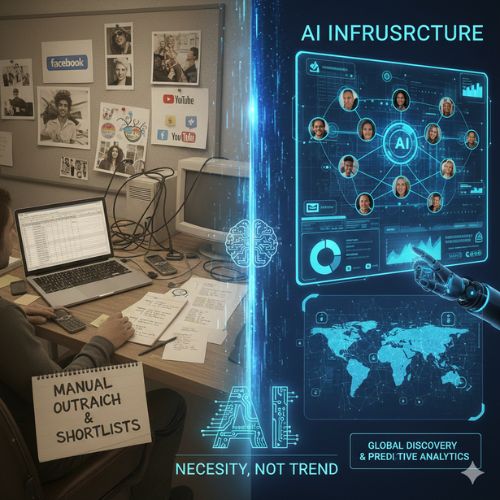
Influencer marketing did not become complex overnight. It evolved as platforms multiplied, creators diversified, and audiences became more selective. What
once involved shortlists and manual outreach now spans thousands of creators across formats, regions, and niches.
Brands reached a point where discovery became so overwhelming because almost everyone was on social media, and measurement became hard. AI did not enter influencer marketing as a trend. It entered as a necessity.
To understand how AI is changing influencer marketing, it helps to see it not as a replacement for creativity, but as infrastructure. AI brings structure to an ecosystem that grew faster than traditional marketing systems could manage.
Why AI Is Needed For Influencer Marketing
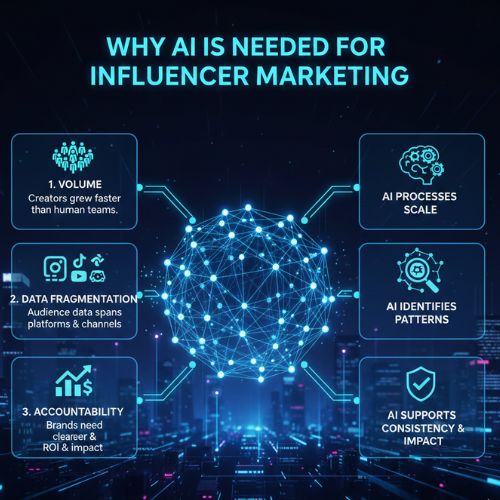
Influencer marketing faced three structural challenges.
First, volume. The number of creators grew faster than human teams could evaluate them meaningfully.
Second, data fragmentation. Audience behaviour spans platforms, formats, and private channels that do not connect cleanly.
Third, accountability. As budgets increased, brands needed clearer answers around performance and impact.
AI addresses these gaps by processing scale, identifying patterns, and supporting consistency where manual effort falls short.
How AI Is Changing Influencer Discovery and Matching
Influencer discovery is where AI’s impact is most immediately visible.
Traditionally, discovery was heavily dependent on hashtags, follower counts, and manual shortlisting
AI shifts discovery toward audience intelligence and alignment.
How AI improves discovery
- Analyses audience demographics, interests, and behaviour patterns
- Identifies audience overlap between creators and brands
- Evaluates tone, content themes, and brand safety signals
- Surfaces creators who align culturally, not just numerically
This means influencer selection becomes less about popularity and more about relevance.
AI does not decide partnerships on its own. It narrows the field intelligently, allowing human teams to make better final decisions.
The more ways AI is revolutionising Influencer marketing are
Predictive Analytics: Planning Before Launch, Not After
One of the most significant ways AI is changing influencer marketing is through prediction.
Instead of asking, “How did this perform?”, brands can now ask, “How is this likely to perform?”
AI models can forecast:
- Estimated reach and engagement
- Audience response likelihood
- Conversion probability based on historical patterns
- Budget efficiency across creators
This allows brands to plan strategically, allocate budgets more responsibly, and reduce performance uncertainty before campaigns go live.
AI-Powered Fraud Detection and Trust Building
Influencer fraud is not always obvious. Fake followers, engagement pods, and inflated metrics often appear legitimate. When this happens to trust becomes very difficult.
AI improves trust by:
- Detecting unnatural engagement patterns
- Identifying follower growth anomalies
- Flagging bot-driven interactions
- Analysing consistency across content history
This protects brands from misallocation and helps genuine creators maintain credibility. In this way, AI strengthens the ecosystem rather than policing it.
Content Creation and Optimisation
AI supports creativity the best. Creators and brands now use AI tools to:
- Analyse content performance patterns
- Generate content ideas aligned with audience interest
- Optimise captions and posting times
- Support video editing and formatting
By handling repetitive or analytical tasks, AI frees creators to focus on storytelling, authenticity, and originality.
Real-Time Campaign Monitoring and Optimisation
Influencer campaigns are no longer static; they move and also create the hype – the one everyone loves.
AI enables:
- Live performance tracking across platforms
- Identification of content momentum or drop-offs
- Mid-campaign optimisation of spend or formats
- Faster response to audience feedback
Automating Influencer Marketing Operations
One feature of AI loved by everyone is its ability to automate. It completely automates
- Influencer outreach and communication
- Contract generation and compliance tracking
- Payment processing and scheduling
- Performance reporting and documentation
This allows brands to manage large influencer programs without losing control or transparency.
Personalisation Through AI
AI can and does even personalise the entire content for influencers
AI enables:
- Content personalisation by region, interest, or behaviour
- Segment-specific messaging
- More meaningful engagement at scale
What was already more personal becomes more personal with AI.
The Rise of Virtual Influencers
Virtual influencers represent one of the most visible outcomes of AI in influencer marketing.
AI-powered virtual creators offer:
- Complete brand control
- Consistent tone and availability
- Cross-platform scalability
- Integration into gaming, AR, and immersive environments
However, virtual influencers work best when they complement human voices. Without emotional grounding, trust remains limited.
How AI Is Changing Influencer Marketing ROI Measurement
Measuring influencer marketing ROI has never been an easy task because influence never drive linear traffic. To simplify the process, AI brings clarity by interpreting the complexity and making the data understandable.
AI-powered systems enhance ROI measurement by:
- Supporting multi-touch attribution models that distribute value across the entire customer journey
- Identifying assisted conversions where influencer exposure influenced consideration, not just the final click
- Analysing behavioural patterns such as repeat visits, content saves, and delayed purchase intent
- Connecting on-platform engagement with off-platform actions like search behaviour and website interaction
The outcome is not artificially neat reporting, but a more accurate and defensible understanding of how influence contributes to real business results.
Risks and Limitations of AI in Influencer Marketing
AI introduces scale and efficiency, but it does not eliminate strategic responsibility. Its limitations become visible when technology is treated as a substitute for judgment rather than a support system.
Key risks brands must account for include:
- Bias in training data, which can reinforce narrow creator selection or exclude emerging voices
- Over-automation, where optimisation prioritises performance patterns at the cost of originality and creative nuance
- Transparency and disclosure challenges, especially around AI-generated content and regulatory compliance
- Dependence on platform data quality, where incomplete or restricted data can skew AI-driven insights
AI should inform decisions, not dictate them. Strategy must always lead, with technology serving as an enabler rather than the driver.
Wondering about the trends, Tools, and Strategies to use AI, read this to know more: AI in Influencer Marketing: Key Trends, Tools, and Strategies
BuzzFame: How AI-Driven Influence Is Built Strategically
At BuzzFame, we treat AI as an assistant. As the best influencer marketing agency in India, with partnerships across 50+ brands, a network of 3,000+ influencers spanning beauty, wellness, lifestyle, and beyond, and over 50 million cumulative reach, we apply intelligence where it matters most. Here, Influencer campaigns are built through audience relevance, content credibility, funnel alignment, and measurable impact. AI enhances decision-making, while creators anchor trust. This balance ensures that we deliver you long-term value.
Influencer marketing has evolved from a trend into a multimillion-dollar industry reshaping brand strategy worldwide.
Embrace The Intelligence
Understanding how AI is changing influencer marketing means recognising that influence is evolving and realising you need to catch up with it.
AI brings structure to creativity. It introduces accountability without stripping authenticity. The brands and creators who succeed will be those who treat AI as a partner in intelligence, not a replacement for human connection.
Frequently Asked Questions
How is AI changing influencer marketing today?
AI is changing influencer marketing by improving creator discovery, predicting performance, detecting fraud, optimising content, automating operations, and enabling better ROI measurement across complex customer journeys.
Can AI replace human influencers?
AI cannot replace human influencers entirely. Influence relies on emotion, trust, and lived experience. AI functions best as a co-pilot that supports creators rather than replacing them.
How does AI help in influencer discovery?
AI analyses audience demographics, interests, engagement behaviour, and content patterns to match brands with creators more accurately than manual methods or follower-based selection.
Is AI useful for small influencer campaigns?
Yes. AI helps small campaigns optimise budgets, reduce risk, and identify high-fit creators, making influencer marketing more efficient even at a limited scale.
How does AI detect fake influencers?
AI detects fraud by identifying abnormal engagement patterns, suspicious follower growth, bot activity, and inconsistencies between audience behaviour and reported metrics.
Are virtual influencers powered by AI effective?
Virtual influencers powered by AI are effective for controlled storytelling and scalable campaigns, but they work best when paired with human creators for authenticity.
How does AI improve influencer marketing ROI?
AI supports multi-touch attribution, assisted conversion tracking, predictive analytics, and behavioural analysis, offering a more realistic understanding of influencer impact.
What risks come with AI in influencer marketing?
Risks include over-automation, biased datasets, reduced creative nuance, and transparency challenges. Strategic oversight remains essential.
Will AI make influencer marketing less authentic?
AI does not reduce authenticity when used correctly. It removes inefficiencies while allowing creators to focus more deeply on storytelling and community engagement.
Is AI essential for influencer marketing in the future?
AI is becoming essential due to scale, complexity, and accountability demands. Brands that integrate AI thoughtfully will gain long-term competitive advantage.